2020: The 50th Anniversary of Earth Day

Fifty years ago, before I was born and as I was told by history, a US Senator from Wisconsin named Gaylord Nelson founded Earth Day after he witnessed devastation caused by the 1969 oil spill in Santa Barbara, California. Senator Nelson and Congressman Pete McCloskey recruited Denis Hayes from Harvard University to coordinate a national staff of eighty-five who promoted events across the US to raise public awareness of environmental issues. On the first Earth Day on April 22, 1970, 20 million Americans rallied together to demonstrate for a healthy, sustainable environment and for protection against the deterioration of the environment. Subsequently, the national movement led to the creation of the United States Environmental Protection Agency (EPA) and a series of bipartisan legislation of the Clean Air, Clean Water, and Endangered Species Acts. In the 1990s, Denis Hayes expanded the Earth Day Network to 141 countries. Today, more than 180 nations observe Earth Day as a global secular holiday.  

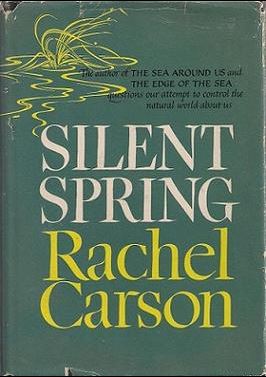
I’m glad that the celebrated alum Rachel Carson from Chatham University is mentioned in the Earth Day history. Ms. Carson’s seminal work Silent Spring (1962) “represented a watershed moment” as history recorded it. (See book cover here) I’m even proud of the United States (in its bipartisan political climate fifty years ago) for leading the country and the world on all forefronts of environmental topics such as water, energy, air and wildlife.

Moving forward fifty years later, in 2020, the US is the only nation in the developed world that has signed but not ratified the Basel Convention on hazardous waste. There is no US federal law that requires the recycling of plastic waste or includes a ban on foreign export of e-waste. And the US is withdrawing from the Paris Climate Agreement under the current administration. The withdrawal will come into effect on November 4, one day after the 2020 US presidential election. Earth Day is more than a one-day demonstration; it symbolizes lifelong civic engagement in fighting for a cleaner, safer, more just and sustainable world.    

It’s a stereotype to label a person who advocates for environment and nature an activist. In some literatures Rachel Carson was regarded as an environmental activist rather than a female scientist. Don’t you think a person who values economic growth higher than anything else is an activist as well? I think in our society we have many a financial activist and economic activist who has led, or misled, us toward wasteful consumption behaviors and money-oriented mindset. We’d rather cover our ears and eyes to the truth, allowing such activism to dominate our lifestyle and judgement.

I’ve been told by people with high socioeconomic status that in a capitalistic country such as the US, it’s not uncommon that people with power monetize strategies in order to make a change for good intention or not. You can reward someone with a buy-one-get-one-free coupon, for instance, for buying your new product. You can also reward someone with a big fat bonus for not going to a competitor company. There’re too many examples like this. We can reward someone for doing something or not doing something. We can penalize someone with fines for breaking a rule. Corruption involves bribery, and bribery is about money. No matter whether corruption gets full explosure, corruption is happening in businesses and in governments. Money means a lot to all of us but it’s not everything. When we feel the economic pinch such as COVID-19-related unemployment, we ask for help from our employers and governments. A trillions-of-dollars-worth economic rescue plan is granted.

But what about a pay cut or job loss resulting from poor health or the need of caring for newborns and an ailing family member? The healthcare system in the US is far from good compared with OECD counterparts, a club of industrialized countries. American people need to wait for days and weeks for non-emergency medical consultations. Administrative bureaucracy is as cumbersome in the health industry as in governments. And many people’s insurance premiums go up year-on-year, and yet the services dwindle and a wide range of exams and drugs are not fully covered. Many folks who died of COVID-19 could not even afford proper healthcare because they were mentally, physically or even financially unable. Do health inequities get the same bipartisan attention as wealth inequities from our governments?

What about the burdensome price tag of daycare to many new parents? Politicians like using zip codes to gauge their polling demographics. The longer I live in America, the more I understand why zip codes unofficially determine Americans’ social status. Different zip codes do matter in the education quality of a child and the accessibility of fresh produce and a healthy diet in stores. Different zip codes do demonstrate the administrative discrepancy in exercising the voter’s right and pricing the same consumption goods in different chained stores. All of this, health, education, and employment, is social capital. As we look back the last 50 years from the first Earth Day, in the US and many capitalistic countries, economic growth has outpaced social development. 

If you’re an economist or like one, perhaps you’ll agree with me that we’re all activists because we advocate for different needs. In order to survive, we have our needs and we demand our needs to be fulfilled. For sustainability, we value individual wellbeing as much as our material needs.

Ideally, if a majority of global citizens can benefit from a good quality of healthcare, affordable housing, lifetime education, efficient mass transportation and safe and sustainable food sources, we will do less damage to the world of finite natural resources and the ecosystems on which other living things—other than humans—also depend for their survival.

What if part of the trillions of dollars rescue package is allotted for creating jobs to build healthy, sustainable institutions and systems for social capital? Will we be less susceptible to risk that will cost us more to rebuild than to prevent that risk from happening?

On the 50th anniversary of Earth Day, the first (or maybe the only) 50th anniversary that I observe in my lifetime, I think we really can do a lot for not only the voiceless environment and endangered species, but also for our own survival on this Planet.

Waste management is a big industry. How can other living things live for tens of thousands of years without causing environmental disasters? Animals also pee and poop in their own right. Plants emit carbon dioxide at night when sunlight is not available for photosynthesis. Humans produce waste: solid waste, food waste, electronic waste, packaging waste, water waste, air pollution, to the topical medical waste, you name it. It’s inevitable that we’ll handle tons of medical waste during and after COVID-19. But the human waste seems to contribute little positively to the environment. Mother Nature has her limits to turn waste into treasure, but humanity’s ingenuity is boundless. Sadly, we haven’t acted quickly to protect social and natural capital as we did to rescue our economy in the fallout of COVID-19. Don’t you see there’s a problem but also an opportunity for humans to invest in waste management?

To celebrate Earth Day 2020, I’d like to borrow the statement from earthday.org to remind us all: “We have two crises: one is the COVID-19 coronavirus pandemic. The other is a slowly building disaster for our climate.” If only the United States could once again lead this climate movement. If only we, the capable, could help those underprivileged to increase social mobility, our world will be a better place—like Michael Jackson sang—if we make efforts toward inter- and intragenerational equity and sustainable development.
The Untedious Easter Discovery

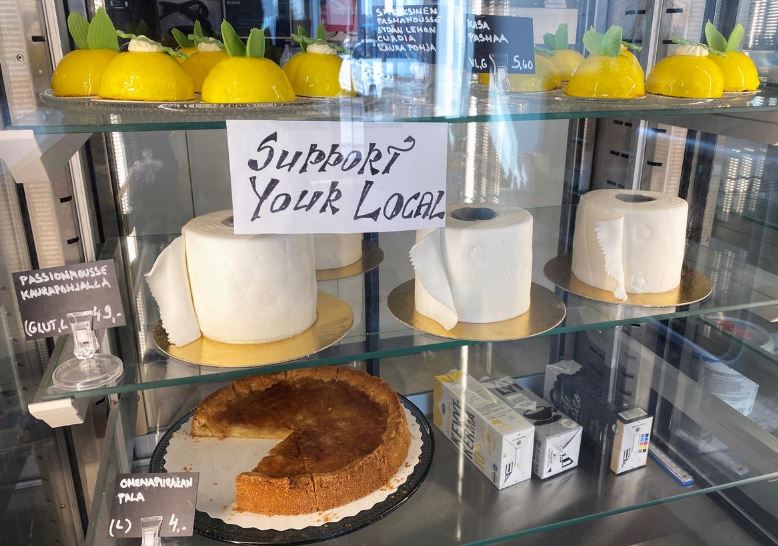
Umm. . . how about a toilet paper cake? (Photo courtesy of REUTERS/Attila Cser.)

If you feel every day is like a Groundhog Day under the COVID-19 stay home order, you’re not the only one. I’ve been telling my friends that the garbage truck comes twice a week in my neighborhood to collect trash. That’s how I anchor myself to the day of the week. Instead of having a window view of an empty parking lot all to myself during the day, I’m now writing at home with a view of a parking lot filled with cars every day. 

This is an unusual Easter. Let’s not get used to this new normal where the Internet and online activities are penetrating every aspect of our life. The spring is outside. The hens are laying eggs as usual, no day-off! 

This is an unexpected change of routines for many people. Let’s take it as godsend bliss. We spend more time with immediate family members now. We discover what we don’t know in the household or reacquaint ourselves with what we know. We may understand the deeper meaning of “Home Sweet Home” as we live in it.

This is an untedious period of learning. We learn to love and relove a hobby or a living thing. We reflect on what we had and did pre-lockdown to allow us to cherish our life and respect for others. Our Planet is celebrating the 50th Earth Day on April 22 merrily, because after a very long time living things—other than humans—can now breathe the fresher air, sing in a quieter common land, and frolic in clearer waters. Villagers in northern Punjab India can see the Himalayas clearly for the first time in almost 30 years due to the clearer air because of India’s lockdown.  

To break my cabin fever, I’ve done something different this Easter weekend at home. I tune into the sound of coronavirus (click here to sample), which is a nearly two-hours of pure music consisting of chime bells, twanging strings and lilting flutes. MIT scientists have translated coronavirus protein structure into music to find sites on the protein where antibodies or drugs might be able to bind. This is a new technique called sonification. Scientists assigned each amino acid a unique note in a musical scale, converting the entire protein into a preliminary musical score. While listening to the soothing sounds representing the coronavirus spike protein, I doubt the virus is that spiky. The sounds aren’t pitchy to me at all. I can easily fall into my auditory hallucinations. So to stay sober I change the music channel to this ensemble by 45 French musicians singing from their homes the famous 60s oldie “La Tendresse.” The song was first sung by French comedian and singer Bourvil in 1963. Be sure to watch the scene in which Aurélien Merle in Augères-Bourgogne used several rolls of toilet paper as his props.

For weeks, I’ve been looking for an explanation to satisfy my bewilderment that why toilet paper is one of the most-wanted items for people to stock up, especially in the West. (Chinese people were queuing for masks at pharmacies as the epidemic news broke.)

It’s been weeks now (at least during my rare visits) in my local stores that shelves for paper towels and toilet paper are empty. I was surprised to see the last toilet paper package in my recent hunt for essential goods. Standing on the shelf was the one-and-only six-roll item. It cost more than six dollars, pre-taxed. If my father were with me, he’d convert the US dollars into RMB, the Chinese currency. “OMG!” He’d most likely scream and said, “Nearly fifty yuan for six rolls of toilet paper!” With this amount of money, one can have three meals at a noodle shop in Guangzhou, China.  

What makes us no different from one another regardless of nationalities and races is in the face of a pandemic, we see panic buying everywhere in the North or South Hemisphere, Eastern or Western world. Toilet paper is a must-have. I come across this article from the World Economic Forum and it’s given me food for thought. As Niki Edwards from Queensland University of Technology said, “Toilet paper symbolizes control.” To maintain control in an uncertain time, amassing toilet paper satisfies our mental need of maintaining control over hygiene and cleanliness.

I’m amused by Brian Cook from University of Melbourne’s view that the bulky toilet paper can provide visual contentment to panicky mortals. By looking at the toilet paper stockup in our home storage, we can tell ourselves that we’re doing something and we’re protected in the abnormal time when we feel at risk. And Alex Russell from Central Queensland University believed that nothing can substitute for toilet paper in terms of its functionality. In my sustainability study, I’ve learned about fungibility, an economic term meaning the ability of a good or asset to be interchanged with other individual goods or assets of the same type.

So dear reader, if you want to make a difference for our Planet, buy or stock up, if you will, eco-toilet paper, which as its name suggests, is made out of recycled materials. I remember in the 80s and 90s companies were discussing how to reduce overhead expenses by introducing a paperless office. Now we’re more paperless than not because of emails, smart phones and cloud computing. I haven’t seen a way out yet to a paperless bathroom. However, if you’re smartly swerving to eco-toilet paper, such as Ecoleaf, Essential, Traidcraft and Who Gives A Crap (the recycled paper version), we can do our parts to reduce deforestation. Forests, like those that were burnt in California and Australia or cut down in the Amazon and East Africa, are the Planet’s lungs to absorb emissions.

If we have bad lungs, we’re unlikely to survive in the battle with novel coronavirus.

If the Planet has bad lungs, we’ll inhale as much bad air as all living things need.

If you become a toilet paper collector like Juli Gudehus from Germany, or a small business innovator like the owner at Ronttosrouva bakery from Finland who turns rolls of toilet paper into a cake design, you’ve made your 2020 spring an untedious one.

(Music “We’ll Meet Again” arise. Lights out.)

Wanna leave a comment? Click here.

Unintended Rewilding

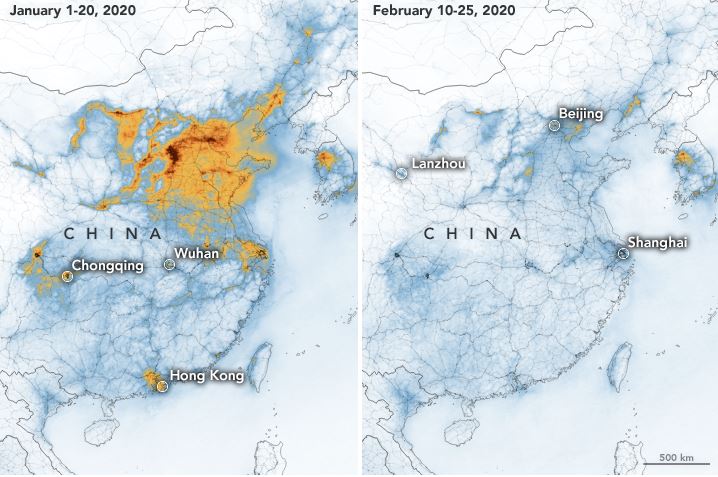
Photo courtesy of NASA which shows significant decreases in nitrogen dioxide over China from January 1 to February 25.

Economists foresee that the future trajectory of the stock market will follow the trajectory of confirmed COVID-19 cases. They have an inverse relationship. The more cases of coronavirus, the poorer the stock market will perform. Environmentalists see the same inverse relationship between human activities and the health of the Planet. Roughly speaking, the more pollution caused by social and business interactions in the Anthropocene, our present geological age of man, the less healthy the Planet. COVID-19 is a test run for humanity to survive in a virtual-dependent world, e-clinic, e-grocer, e-library, e-market, e-school, e-office, e-recital, e-trade, e-cinema, as many e- affixes you can think of.

When China was at the brunt of the COVID-19 outbreak in January, all factories and businesses in the country were closed by law to curb the spread of coronavirus. Chinese people had celebrated one of the quietest and scariest, if not the quietest and scariest, Chinese New Year at home for two months. Mass transportation was suspended or service hours were reduced in many cities. Communities including residences and businesses shut their doors to returning migrant workers after the biggest traditional holiday for fear they would bring infectious disease. So production lines were delayed to resume until early March. Wall Street tumbled partly because the Chinese suppliers to big American firms couldn’t operate their machines and Chinese stores of multinationals were vacant under stringent nationwide disease control measures.

However, the temporary halt of supply chains and retail store traffic brought good news with decreases in nitrogen dioxide over China, according to the satellite data maps from NASA and the European Space Agency (ESA). Nitrogen dioxide primarily gets in the air from the burning of fuels and contributes to the formation of acid rain and ground-level ozone. (See image above)

On the one hand, economists worried as the COVID-19 outbreak in China in early February drove global oil prices down from $55 a barrel to $50 (the prices fell even further in mid-March to below $30 for the first time since 2016). The drop was the result of an energy pricing tug-of-war among the US, Russia and OPEC, a multinational group of oil producers led by Saudi Arabia. On the other hand, environmentalists cheered. The change of color on the satellite data maps showed airborne nitrogen dioxide drop from high-density crimson red to mean-density azure blue. China’s sharp reduction in energy demand in response to the government’s lockdown measures cut the country’s carbon emissions by about 100 million metric tons over two weeks in mid-February, marking the first decline in emissions in three years.

A similar nitrogen dioxide emissions drop was detected over Italy after the country began lockdown on March 8. You can see the gradual change of color in the ESA animation video.

Social media unleashed the wow factor after the surprising discovery that the murky canals in lockdown Venice looked clearer; live fish were visible in the water below. The mass social distancing and reduction of tourists and traffic in Italy definitely have contributed to the temporary good health of the country’s emissions—if the pandemic is infectious globally, so is the rise of greenhouse gas emissions as a result of the free trade and freedom of movement that the West values most.

Biologists and environmental scientists are hotly debating rewilding to reintroduce once-lost keystone plants and animal species to restore our nature. The acceleration of human activities such as population growth and economic development after 1945 at the cost of natural capital are to blame for that lost nature. Humanity is paying a heavy price for the COVID-19 pandemic which originated from humans trading in wildlife, but which may lead to an unexpected rewilding in this quieter spring.

In ancient times, our forebears, without the knowledge of science, believed infectious diseases were an omen of the wrath of God. We know better now. But suppose the COVID-19 outbreak is an unexpected godsend for humanity to learn from the clear water with fish in Venice, the chirping birds in China, and the lonely but abundant cherry blossoms at the Tidal Basin in Washington DC. They are somehow surviving, even flourishing during COVID-19. But what if global warming threatens them as well as costs lives and economic losses on the scale of COVID-19 or greater? Will humanity learn the lessons of COVID-19 and prepare to prevent and cope with the climate crises of the future?    

Wanna leave a comment? Click here.

Data, Battery, and My Smarter-Than-Me Phone

I was dumbfounded at receiving a text message from my wireless carrier in late March. It read: “We have added 15 GB of data to your plan at NO CHARGE for use from 3.25-4.30. No action is needed.

Fifteen gigabytes of data is not a small number to me, considering my phone data plan has only one gigabyte monthly. So my first reaction was in disbelief. I thought it was some scam or a sweet doughnut fallen from the sky to entice me to buy a new product. I have no faith in my wireless carrier yet.

I read the text message a couple more times. Ok, the capitalized “NO CHARGE” finally sinks in. But I’m still skeptical—after all, why does my phone carrier all of a sudden become so nice to me? What’s the intention behind it? My cynical Chinese-consumer mind has sounded an alarm: there is no free lunch in this world. I’m well-trained in China to question before I sign up for anything to avoid buying counterfeit goods or paying a high price for them.

I learn that other US phone carriers have made efforts in removing data caps to keep customers connected during this uncertain and difficult time of COVID-19. Nice move. I wish I could roll over my unused data to the following months. But there is no such perk in my phone plan.

When I tell my Chinese friends about my one-gigabyte monthly data plan in the US, they’re dismissive and proud to compare mine with their data plans which are in double-or-three digit gigabytes. They tease me that if I visit them in China, they can give some of their data to me through a mobile hotspot with no string attached. What a philanthropic gesture!

However, I can’t offer the reciprocal favor to my friends if they visit me in America. Data, data, data—companies love them so they can optimize their products based on customers’ data. Digital device users can’t live without data, especially now when we’re practicing social distancing and our communications in the virtual world are so reliant on data. But I don’t see there’s any price competition in the near future for data plans provided by the US phone carriers. Alas, welcome to capitalism!

Since I don’t go out much, even I do, my main concern is not data but the percentage of battery left on my phone. These days the data-hungry apps on the phone will drain my phone battery as much as my data allowance. The app developers are cunning to get my consumer’s data without notifying me. This is how they do: When an app is updated, the new version is usually upgraded to the developer’s advantage. Notifications and other privacy setting features are set to “on” or “allowed” by default. For those phone users who know little of this setup, they’ve already opened a window of their personal information to data-hungry voyeurs.

To wisely spend my phone battery as well as my meager one gigabyte monthly data allowance, I have to manually turn off the default setting of my apps if I don’t want to be tracked. Upgrading my apps can fix bugs and loopholes of those apps, but the more often I update my apps, the quicker my battery will be used up. To some extent, I find my phone is like an oxygen-deficient patient who needs to carry a portable oxygen concentrator constantly. If only we had new batteries that could regenerate by themselves. If that day arrives, we won’t see so much hazardous e-waste dumped in the landfill.

Whether it’s battery or data, I have to marvel at my phone which is so much smarter than me. Without the phone, there won’t be a body to carry a battery and receive data. If I have any questions, I just type my questions on my phone, or even just ask my phone with simple questions, the phone will talk back to me. I’m thinking about what sort of facial expression our great Albert Einstein would put on his tongue-sticking face if a smartphone talks to him about his discovery of mass-energy equivalence, the famous formula E=MC2. Since I can’t roll over my data for future months, I have to think hard how to use up the additional 15 GB of data before expiry and also without draining too much of my phone battery. Data, battery, and my smarter-than-me phone, they have made the Internet penetrating into my life during COVID-19 much deeper.  

Wanna leave a comment? Click here.     

The Word of the Year for 2020

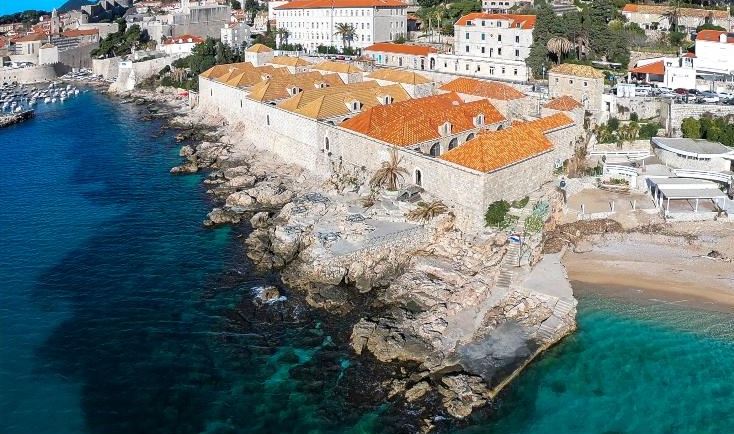
A bird’s eye view of Dubrovnik, Croatia.

We’re only at a quarter away from the beginning of 2020—the last year of a decade. I’m confident that the word “coronavirus (COVID-19)” is very likely to be selected for “The Word of the Year for 2020.” The global impact of this pandemic is far and deep on our life physically, mentally, socially, economically, environmentally and even politically.

Since the outbreak was first reported in China last December, I’ve written about COVID-19 and its related subjects twice. (See “Wuhan Pneumonia” and “On Different Kind of Guns”) Not because COVID-19 is a disease permeating our media airwaves now, but because even when we get through this difficult time, our worldview will be forever distorted as a result of the dramatic development of this piece of human history.

Linguistically, the “stay at home” order in the English world (in German: #bleibzuhause / in French: #resterchezsoi) implies self compliance to distance oneself from other human beings who are not cohabiters under the same roof. In other words, social distancing does not apply to cohabitation, including our pets. Humans are social animals. That explains why animal shelters across the US are reporting upticks in fostering pets during the fallout of COVID-19.

I see the “stay at home” order in the West as a relaxed version of house arrest. Like those in Spain, pet owners in France are allowed to walk their dogs in their immediate neighborhood. Dog-walking even becomes a spontaneous money-making business in lockdown Spain—dogs are for rent in local classifieds sites just to give bored humans an excuse to get out of their confinement. A social media post has sparked viral humor that a dog was borrowed by neighbors and was taken out 38 times in one day.  

China also implemented a “stay at home” order (in Chinese: 强制隔离, literally means “coercive isolation”) at the onset of COVID-19 in January. The top-down mandate was gradually relaxed in March as the country sees the infected COVID-19 cases declining. The degree of law enforcement in China then could be compared to, more or less, house arrest. House arrest is a legal terminology to describe the state of being kept as a prisoner in one’s own house. Chinese governments, from central to local levels, are serious about containing the infectious disease by all means. Regulations, fines, imprisonment, revocation and shame and blame, every measure you can think of has taken effect.

In my opinion, quarantine is a medical synonym for house arrest. For centuries, the rules of quarantine are unchanged, so is the public consensus about which contagious disease is a public health crisis. People have to stop the infections as quickly as possible through isolation, perhaps even solitary confinement. A recent article by AP about how Croatia’s Dubrovnik applied ancient quarantine measures in the 14th century has piqued my linguistic interest in the etymology of quarantine.

In the 14th century in Dubrovnik, an UNESCO heritage site in Croatia, travelers and tradesmen coming from regions affected with leprosy, plague or other diseases had to stay at least 20 days in isolation. The time limit was extended to 40 days, or “quaranta” in Italian, hence, giving the practice its future name.

The Venetian policy (first enforced in 1377) required keeping ships from plague-stricken countries waiting off its port for 40 days to assure that no latent cases were aboard. Also, earlier in English, the word “quarantine” meant “period of 40 days in which a widow has the right to remain in her dead husband’s house” (1520s), and, as quarentyne (15c.), “desert in which Christ fasted for 40 days,” from Latin quadraginta “forty.”      

So back to modern days, if we are asked to “stay at home” for 15 days at least in response to curbing the spread of COVID-19, this order is much less draconian than our ancestors’ quarantine rules. The ordeal is not yet ended—both for now as we are looking around the four walls of our comfortable space of home (think about those homeless, though) and for the future as we ponder the lesson we learned from this world war of public health in the 21st century.

Accompanied with the German song of “stay at home,” I sympathize with COVID-19 victims and their loved ones. I’m grateful for the fighters from all walks of life in the frontline against the pandemic. Perhaps, COVID-19 is forcing humanity to respond, reflect and review what we deem as “normal practices” and “safe systems” are no longer working effectively. At least on my part, COVID-19 will give me a lot to think about linguistically.       

Let’s sing in German “stay at home” for solidarity.

“If you want to do a virtual tour of Croatia’s Dubrovnik, click here for Lonely Planet’s visual sensation and more.

My Afterthought of China’s Second Continent (Part II)

(Continue Part I)   

In French’s nearly all of the 270-page manuscript of China’s Second Continent, I relate to every personal account. French’s interviewees in nonfiction are like characters in fiction. I prefer calling them characters anyway. So every character comes alive when they speak. One thing I notice is unlike the coolies and poor-stricken laborers in the 20th century who traveled across the sea from China to Southeast Asia and North America, the Chinese migrants to Africa in the turn of the 21st century worked either with a state-owned enterprise or as the first batch of college grads with a foreign language major. In other words, the Chinese in Africa were not illiterate. They received some education at home. They might not speak a foreign language but they were party loyalists for sure.

I was still young when China sent tens of millions of laborers abroad in the 1990s. Many of them went to the developing countries in Central Asia, Africa, South America, you name it; or to the developed countries in the EU and North America where there was a shortage of professionals in such fields as nursing and a shortage of others to do dirty, manual labor jobs. And most important, where there were Chinese state-funded projects abroad, there were Chinese workers.  

As French wrote, “Chinese had been coming here [Zambia] in substantial numbers since the 1990s, earlier than to almost any other country on the continent. By now [as of the writing of the book] they numbered 100,000 or so by some estimates, making them one of China’s biggest migrant communities in Africa.”

Economic migration is a norm in the 21st century. During the same time, tens of thousands of African traders resided in China. Guangzhou was one of the biggest African hubs in the country. Before my literary exposure to Africa, my understanding of Africa was through these foreigners in my hometown.

In his book, French tries to strike a balance between the way the Chinese opportunists see Africa and how Africans see the Chinese in Africa. The negativity about the Chinese influence in Africa is prevalent throughout the book. I find it ironic that the Africans in the book blame the Chinese for local problems, likewise, the Chinese back at home in Guangzhou, in particular, also blame the African traders for the city’s social problems.

But nobody—neither the Africans nor the Chinese—says no to an inexpensive business deal offered by the Chinese to the Africans. Nobody, not even the US or the EU, intervenes or reminds the Africans of the irrevocable trade-off in these deals on their natural resources and people’s wellbeing.  

China is known for tofu-dreg projects—structures that are as flimsy and porous as tofu dregs—at home and now abroad in Africa. The author has mentioned a few poorly-constructed, made-by-Chinese projects in his book. When Wenchuan Earthquake happened in 2008, the Sichuan provincial authorities tried all they could to cover up the tofu-dreg projects that led to thousands of schoolchildren buried under the debris of the poorly-constructed classrooms.

Africa needs a second or a third contractor other than China to compete for projects. Africa needs continental financial benchmarks and regulations on foreign investments and the use of resources. Africa needs more intergovernmental treaties to protect the African consumer and labor rights and safety. Africa needs more local born-and-raised entrepreneurs and business dealers. I’m glad to learn that Rwanda has launched the first “Made in Africa” smartphones to compete against China’s phone monopoly in the market.  

China builds infrastructure in Africa while the US provides medical and education to the African people. I find that these two actors are like the US politics where the Republicans focus on hard power like defense and send more troops abroad, and the Democrats focus on soft power like diplomacy and increase spending on the African poor.

Never fall into the Chinese’s win-win rhetoric. On the one hand, hiring Chinese to work abroad looks like spending abroad, but the workers’ wages are actually part of China’s GDP (This tactic reminds me of the incumbent US President’s shifting official to his hotels and resorts). On the other hand, when the bridges, roads and other infrastructure projects begin making profits, African governments have to pay back China’s loan. It’s still advantageous to China’s balance sheet, not to the debtors.

The Chinese don’t, or in their words, slowly, teach African people skills. The Chinese’s bias about Africans’ intelligence echoes racial bias in the US. When can humanity put down our sunglasses to see one another’s true colors?

To do it right, we need to empower African people with knowledge and education. As a proverb goes, give a man a fish and you feed him for a day; teach a man to fish and you feed him for a lifetime. We need more African leaders like Nelson Mandela, Kofi Annan, Abiy Ahmed, Wangari Maathai, Miriam Makeba, Ellen Johnson Sirleaf and many more.

I can’t agree more with Ghanaian Albert Osei, one of French’s interviewees. He said, “China’s involvement should help us change the terms of engagement with the West, in order to gain greater equity, more parity. If the West is jealous of China, we should say to them, Train our people and give them a bigger role in your companies. Don’t complain about the Chinese. Help us move up the value chain. Do this, and we will love you.”

No matter if it is an emerging economy like China or the rich world, we are writing our history by our deeds. Historically, we are all in debt to the African people because for many generations we have achieved our prosperity at the cost of their well-being.

My Afterthought of China’s Second Continent (Part I)

Speaking of Africa, I associate it with American travel writer Paul Theroux. His writing about Africa is one of my early exposures to this lesser-known continent. If reading Paul Theroux’s work arouses my curiosity, reading Howard French’s China’s Second Continent hits home.

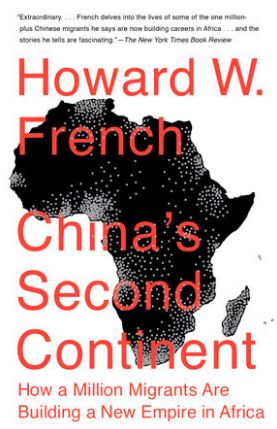
The full title of the book is China’s Second Continent—How a Million Migrants Are Building a New Empire in Africa. This is not a new book. It was published in 2014 and was French’s 3rd book. I picked up the book as part of my research for my own book project. This was how I got to know French’s remarkable journalistic repertoire about Africa and China.

As the author wrote, “With two billion Africans, including vastly more people who will have attained middle-class status or better, and over a billion Chinese, whose lives will be much more affluent, much more globalized and deeply involved in every corner of the world, it was possible to imagine the unfolding relationship between China and Africa as one of the most important in the world.”

Former President Barack Obama once said the US-China relationship is the most important bilateral relationship in the 21st century. If that’s the case, the development of Africa, directly or indirectly, matters for US’s economic growth as well. China is the biggest exporter to the US. And yet, China is hungry for Earth’s finite resources for its supply chains. China is providing goods to its own domestic market with the world’s largest population and to the US and other countries. No way can China meet this gigantic demand without absorbing raw materials from elsewhere.

When the Europeans colonized African countries four hundred years ago, they were doing the same to extract local resources for their own economic growth. Four hundred years later, Chinese opportunists craved the natural resources on African soil—from metals and timber to arable land and fishery—as much as the European colonists in yesteryear. The European colonists gave no damn about the economic and environmental growth of their colonies, neither about the wellbeing of the African people. Instead, they exploited both natural and social capital. The study of the transatlantic slave trade led by Glasgow University will shed more light on the human exploitation during colonialism.

Several times the author writes that the Chinese disagree that their presence in Africa is synonymous with colonialism. In their eyes, the Chinese provide opportunities for them and the Africans by taking on infrastructure projects. It’s a win-win deal as the Chinese believe in French’s book.  

There is no slave trade in China’s economic exploration of Africa. But according to French’s accounts, fewer local workers are hired by the Chinese infrastructure projects; and they receive much lower pay than the Chinese workers. While the Chinese workers get better work safety protection on a metallurgy site, their African counterparts wear near nothing or shoddy materials for protection.

This condition reminds me of an award-winning documentary film, American Factory. In the film, the Chinese workers get the job done fast and in great quantity, and yet, the employer neglects the workers’ safety and well-being. The employer dismisses American workers who form a labor union and fight for labor rights. The operation in Africa is no different, and even worse. I sympathize with those angry African workers and activists.

(To be continued click here)

On Different Kind of Guns

from Chinese social media 2/28/2020.

As seen in above video, Chinese law enforcement is really dead serious about the coronavirus (COVID-19) prevention and containment. If you read Chinese, you’ve probably figured out the exercise in the video is treated as a “counterterrorism drill” as the Chinese characters read in the blue sign.

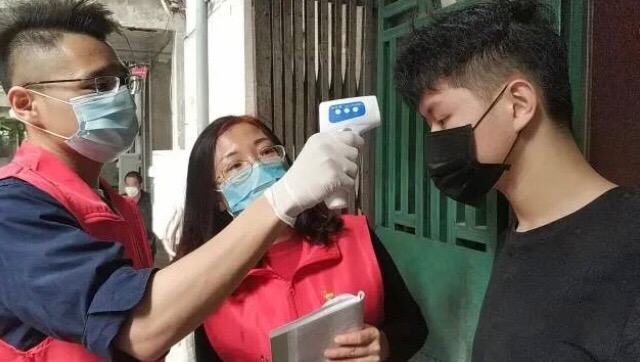
I know how heightened the security is in every Chinese community, large and small, from residential complexes to public places such as schools, office buildings and banks. Security guards and staffers hold up thermometer guns to test body temperature of every individual at the entrances to these places. One of my friends in China said jokingly that everyone had to be “gunned” (test body temperature) so many times a day, they were about to “gun down” (tired out) from the daily repetition.     

Mask on, check! Body temp, check!

I doubt the US law enforcement will follow suit, especially under the current administration which sends false messages on a daily basis. In hindsight, I’m glad that COVID-19 outbreak did not start in the US. Local US governments are scrambling to prepare as many test kits as possible. The test kit has three components, two of which test for the novel coronavirus and a third for a host of other viruses. In addition, the US needs more thermometer guns in place.

If the US federal government would regard COVID-19 outbreak the way American authorities regard a real-life mass shooting, perhaps the high-ranking officials will not be so careless in handling public information. Almost always, the US law enforcement will lock down a whole community after a hot fire mass shooting. Will authorities take the same precaution for COVID-19? Will they exercise a drill the way China does to prepare for the worst?

Although I wonder if China’s top-down mandate to control COVID-19 will lead to the abuse of law enforcement, I also worry about the Trump Administration’s overly-confident attitude toward uncontained coronavirus precaution.  

To some extent, mismanagement of public health is scarier than political malpractice. Either reason causes the loss of public trust. And yet, the mismanagement of public health can be fatal.

I want to end with a quote by a Chinese interviewee in Howard French’s book, China’s Second Continent. He said, “China is a bit freer now but still not altogether free. You can’t compare it with Western countries. But at the same time, most Western people probably have the wrong idea about life in China. They think that whatever you do, the Chinese Communist Party is following you around, ready to arrest you. It’s like our ideas about America. We think everybody has a gun in their pocket, and there’s danger everywhere. . . . the news just focuses on the negative. It’s the same with the way Americans think about China. It’s also the same Chinese people think about Americans. Our news always accentuates the negative.”

I’d add the news in China and in the US accentuates the negative about the other. Perhaps that’s why my Chinese friends often ask if America is safe because of the often-reported mass shootings.

Now, in the past weeks, I’ve been asked if America is safe because the spread of coronavirus in the US is uncontained and the thermometer guns are running short. How should I explain?  

COVID-19 human-to-human transmission is confirmed. Stay away from public gatherings. Wash your hands often for 20 second each time. Cover your mouth to cough. Avoid shaking hands.

Click here for CDC prevention guide for COVID-19 outbreaks.

Click here for my afterthought of China’s Second Continent.

Wanna leave a comment? Click here.

From Silent Spring to Silent Sky

1st edition cover

If you ask anyone from China whether she knows Rachel Carson, the chance for YES is slim. But if you ask her whether she knows the pesticide DDT, expect the positive answer. I hadn’t known about Rachel Carson until I moved to Pittsburgh eleven years ago. I was accepted by Rachel’s alma mater, Chatham University, to study literary writing. Since then, my knowledge about Rachel and her seminal work, Silent Spring, among others, has been enhanced greatly.

Rachel Carson is frequently mentioned in my graduate study about writing and global sustainability. Her unequivocal caveat about excessive use of pesticides like DDT that were poisoning food chains from insects upwards feels like today. But what really happens today is that we have another alarming scientific finding—the excessive emission of greenhouse gases from human activities.

The concurrent coronavirus outbreak in China tells us how problems elsewhere can impact us. We are living in a commercially globalized planet. When China suspended all production activities the past few weeks to contain the spread of coronavirus among people, our supply chains of goods and services around the globe were disrupted in a ripple effect. The future analysis of Wall Street is gloomy about the coronavirus concerns, thus stocks slid for four consecutive days as of Feb 25.

The concurrent global warming has prompted abnormal climate patterns and deterioration in the ecosystems. Natural disasters have become more unpredictable and volatile, causing higher risks to living habitats, transportation and the flow of consumption goods. No one wants to see their housing insurance cost rising or learn our food prices are going up because swarms of millions of locusts have ravaged crops in East Africa. 

This spring of 2020 is not silent, far from it. In America, I hear this phrase a lot—The sky’s the limit. If that’s the case, how can we limit our dreams? How can we restrain our potential to explore the impossible?

American astronomer Henrietta Leavitt sparkled the brightest in Lauren Gunderson’s play, Silent Sky. I had great pleasure in learning about this piece of American history through theater art. If you like the book and movie Hidden Figures, you’d find resonances from Silent Sky. A decade before American women gained the right to vote, Henrietta Leavitt and her fellow women “computers” had transformed the science of astronomy. In the Harvard Observatory, Leavitt found 2,400 new variable stars and made important discoveries about their fluctuating brightness, enabling her male colleagues to map the Milky Way and beyond.

From Rachel Carson to Henrietta Leavitt, from Silent Spring to Silent Sky, women, or I should say, women in America, are characterized as a gender of silence. Bear with my deductive reasoning. As I mentioned in my book, Golden Orchid, Chinese people like quoting Chairman Mao Zedong’s famous dictum “Women hold up half the sky.” If that’s the case, isn’t half of the sky in America silent, metaphorically?

Not quite. In fact, I see American women in general are adding volume to the public discourse. The US-originated, global #MeToo Movement speaks for itself. In both America and China, the number of women graduates from universities is slightly outnumbering men. Universally speaking, we give credit to women for their role in our first language since birth, thus we call it the Mother Language. Thanks to language, we’re able to speak out our minds in exchange for ideas and materials to meet our needs.

Being an American woman, I find my biggest liberation is to voice my opinion publicly. In East Asia, I see a trend for educated women, urbanites especially, to speak up. A good sign. But do not misinterpret that if a Chinese or Korean or Japanese woman—it seems I’m often mistaken for either nationalities—does not open her mouth, she is submissive and introverted. Asian women are well-regarded as good housewives and mothers because they are adaptable and resilient. They respect harmony and self-sacrifice.

Pressuring and even torturing relatives and family members are a common tactic for Chinese authorities to silent dissent. While Chinese young women are gradually voicing their opinions subtly without doing harm to their loved ones, a frightening phenomenon is more pronounced than ever among rural Chinese women. According to the World Health Organization, suicide in China accounts for about a quarter of all suicides worldwide. In contrast to the West, more Chinese women than men are killing themselves.

I know that self-destruction is a heavy subject, just as heavy as talking about mass suicide in the animal kingdom, or, as a matter of fact, about mass suicide of hopeless Chinese farmers who attempted to drink DDT outside a government building. Depression is a silent killer. Threats to survival can lead to suicide. Environmental changes increase the risks of suicidal behaviors. Scientists have warned that thousands more people may die by their own hand as Earth’s climate warms.

Environmental changes may trigger change of emotions. If you stand next to a blast furnace in an insulated uniform for long hours, you probably will become more hot-tempered, too. If you live in a run-down house that gives you daily worry about the roof falling and the basement flooding, there is a high chance that you see everything in your life as gray or even dark.

In the ancient days, people learned about the advent of earthquakes or a rainfall by observing the abnormal behavior of animals. Today, a rise in mass mortality events among species has sounded a similar alarm. When supply chains are broken, our flow of consumption goods stops. When food chains are disrupted, our survival as an entire humanity will face unprecedented challenges.

More than half a century ago, Rachel Carson called for science to work with nature. I’m not a scientist but I’m a science believer. And as an American and a global citizen, I’ve witnessed enough unprecedented misconducts and misbehavior of our politicians and policymakers in the past four years. The year of 2020 cannot be silent. Don’t let silence kill our hope and the future of our next generation to reach their boundless sky.     

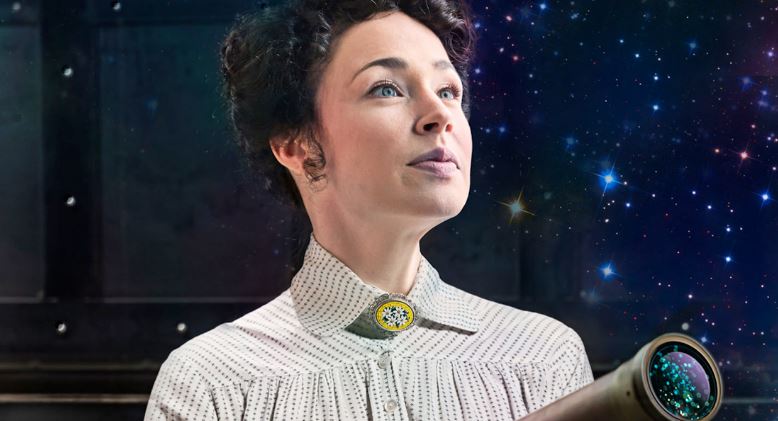
Laura C. Harris as Hanrietta Leavitt in Silent Sky. Photo by Scott Suchman.

“What really made me want to write a play about Henrietta is that her story was not only about one brilliant woman but an entire cohort of women who [were] Harvard ‘computers.’ This was a story about a sisterhood.”   

—— Lauren Gunderson, playwright of Silent Sky

Mother Language Day

2020 marks the 20th anniversary of the International Mother Language Day.

I’m still not quite sure why the world recognizes mother language as the first language we acquire from birth. I believe my father also had contributed a lot to my mother language. In fact, he tape-recorded my early babbles. I remember that I could only laugh at my indistinguishable mother tongue at aged one. My father interpreted the meaning for me which I forget now. But he certainly had a better comprehension than my mother of that old tape in which the baby me sounded like an infant alien from outer space.     

As my interest in my mother language grows, I now know that there is difference between Cantonese spoken in Xiguan—a historical district in Guangzhou, China—and Cantonese spoken in Hong Kong. Strictly speaking, my mother language is the Cantonese that is spoken outside Xiguan. Guangzhou dialect of Cantonese once took Xiguan as its standard. Too bad, I’ve discovered this nuance long after my mother had passed on. I can’t verify with her the origin of our mother language sound by sound and tone by tone.

The United Nations celebrated the 20th anniversary of International Mother Language Day on Feb 21 this year. According to the UN stats, at least 43% of the estimated 6,000 languages spoken in the world are endangered. Less than 100 are used in the digital world. I’ve made a remark about website language in an earlier piece. Click here for 2020: Saving the Endangered Species and Languages.

Although the UN celebration is symbolic, linguistic diversity and multilingualism can’t be more eloquently represented than in this year’s Oscar Awards whose theme is inclusiveness. I’m particularly moved by Best Actor Joaquin Phoenix’s acceptance speech.

The political arena in America and abroad seems to have been in drought for this kind of speech filled with understanding, compassion, altruisticness, self-awareness, empathy, inclusiveness and above all else, peace and love.

We don’t need to understand Korean to watch the winning Best Picture Parasite; we don’t need to disparage others who don’t speak English, Chinese, German, French, Spanish, Arabic and any other major language in the world; we don’t need to disguise our mother languages in public just to prove to others that we are educated and part of the mainstream.

Mother languages bring us a myriad of musical sounds. We are entitled to our cultural distinction as we are to our own opinions. Multilingualism is tens of thousands of times more colorful than monolingualism. A zebra would not be a zebra without the black and white stripes. Do you know zebra literally means “spotted horse” in Mandarin Chinese? I often think of this analogy when I compare Mandarin with Cantonese, or in any situation that I have to favor the dominant language willy-nilly. A zebra without “spots” is just a horse; a nation without linguistic diversity is dull and selfish.         

The Chinese media and local government often boast about Guangzhou as a city of inclusiveness. Because of inclusiveness, bāo róng in Mandarin Chinese, Guangzhou is one of the favorite destinations for non-Cantonese speakers to settle in as their new homes. Because of inclusiveness, non-Cantonese speaking new immigrants embrace their own dialects as well as Mandarin Chinese, which is mandatory in China. Appointed officials in Guangzhou do not bother to learn local Ningnan culture and Cantonese to assimilate. On the contrary, a coercive measure to use Standard Mandarin in public is enforced. Thus, the number of Cantonese speakers in Guangzhou has drastically dwindled in the past fifteen years.

Unlike the elistic Beijingers who blame migrant workers for urban overcrowding and poor sanitation, Cantonese people are inclusive to their compatriots across the country. However, the government has taken advantage of Cantonese natives’ good inclusiveness to enlarge the influence of Mandarin at the cost of the local language.

When we believe our language is better than others, our worldview is doomed to be limited and self-centered. I see there are many languages spoken in the United States. And yet, some native born Americans who don’t grow up in a bilingual setting are prone to have a limited worldview. Speaking English is our blessing to communicate and exchange ideas about our differences. And yet, speaking only English is not enough to understand others.

I enjoy listening to the Spanish-accented English from Sofía Vergara, the Austrian-accented English from former Governor Arnold Schwarzenegger, and the acceptance speech in Korean made by Best Director awardee Bong Joon-ho of Parasite. February marks Black History Month in America. I’m neither black nor white, but I enjoy hearing the African-American vernacular English—a mother language to many African Americans. If only we could speak in comfort with our mother languages and listen openly to many other different sounds of languages. We can make our linguistic world vibrantly colorful. I’d like to end with this video by Tapestry CEO Jide Zeitlin on inclusiveness and diversity.