2019 Hong Kong Protests

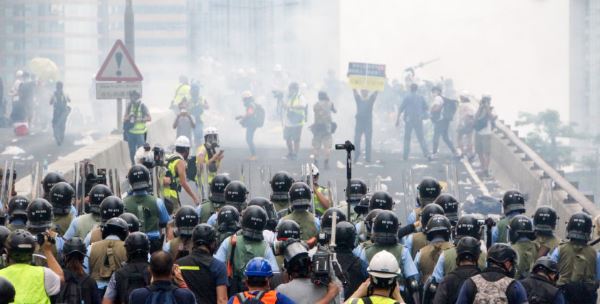
Photo courtesy of The New Daily.

If you’re a Wikipedia fan, you’ll notice there’s a page created and dedicated to the “2019 Hong Kong protests.” With 530 citations, and more to come as the situation is still developing, the Wikipedia page is in great length recording this non-violent-turned-violent political movement in Hong Kong.

The 2019 Hong Kong protest is so close to home. For the past five months, I’ve been hoping to write about it but the situation changes too fast to catch up. The 2019 Hong Kong protest has reached a much larger scale in terms of the impact to the city and the world than the 2014 pro-democracy Umbrella Movement.

I’m saddened that Hong Kong has become a city of polarization. Protesters cannot tolerate different political opinions. They take the most radical way to demonstrate their anger. The pro-Beijing government’s attitude toward party loyalty is non-negotiable. Law enforcement forces also take an aggressive approach to quell the riots. The White Terror is sweeping the international trade hub in the fallout from a series of destructive acts including vandalism, arson, road blockage, physical assaults, confrontation between the riot police and the rioters.

In Hong Kong, doxing is becoming a powerful weapon when a person’s private information is leaked online. The minute after a police officer shot a black-clad protester in Sai Wan Ho on November 11, the officer’s and his family’s personal information was immediately doxed. They even received death threats online targeting the officer’s children. This is not a random practice. In fact, the common practice by protesters has driven netizens, especially those who are pro-police and pro-government to self-censor their online comments for fear of being doxed. Police officers and their families are at risk because of doxing. Because of that, I was inspired to write a short story set in Hong Kong in the backdrop of this protest.

I’m angry that Hong Kong has become a city of chaos. Mass transportation is what I treasure and brag about the most in this city. But now major highways are blocked by barricades, chairs and construction materials; roads are impassable because bricks are dugged out and laid on the surface as obstruction. Railway tracks are dangerous for service trains after abandoned bikes are left on the tracks. Even fire was set on the tracks. Ticketing machines and the entrance at the metro stations are smashed, burnt and blocked.

When I visited Hong Kong airport as a transit passenger this September—just a few days after the protest had paralyzed the airport—it was quieter than my last visit. I realized how serious the situation had become. Posters and electronic bulletin boards at the airport officially announced a long list of banned weaponry to bring into Hong Kong. Many of them have been used in the violent protest today.

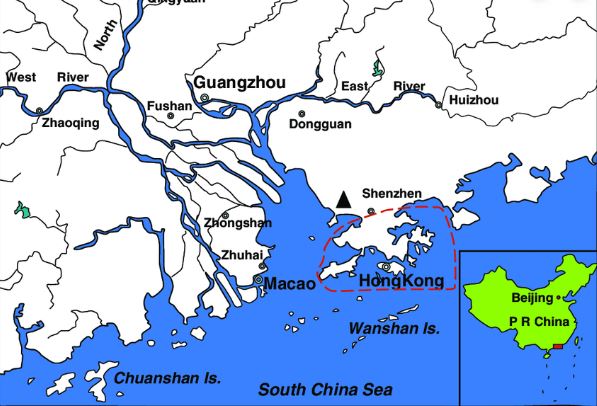
In my memoir Golden Orchid, I mentioned how close Guangzhou and Hong Kong were geographically, in language, culture, trade and even in political stance toward Beijing. So when Hong Kong protests broke out in June 2019 surrounding the controversial extradition bill, I felt extremely uneasy. I’ve witnessed how the central government solidifies its power in every corner of mainland at all costs. Just a look at the Cantonese language. The number of native Cantonese speakers in Guangzhou has dwindled in recent years as a result of the domestic migration of new residents, many from non-Cantonese speaking towns and cities, and as a result of the nationwide Speak Mandarin Campaign that wipes out the local languages.

If Hong Kong becomes just a Chinese city like others in the mainland, Mandarin speakers will soon dominate the upper class of Hong Kong society. Gradually, Mandarin will become the lingua franca in Hong Kong, just like what is happening today in Guangzhou. According to some statistics, since the Hong Kong Handover in 1997, more than one million new immigrants from mainland China are living in Hong Kong. At least two million new immigrants moved to Guangzhou metropolis between 2007 and 2017. The wealthy and democratic places on earth are always attracting new immigrants. Hong Kong is one of these special places in Greater China. Subsequently, the local culture, including language and lifestyle, will face challenges from the outsiders. How to coexist is the key question between the natives and the newcomers. 

In the past week as the situation develops much nastier and out of hand, the Hong Kong protest looks pro-democracy, but it is also a result of cyber-terrorism. The Special Branch division under British rule, which handled intelligence duties, was disbanded before the Hong Kong Handover in 1997. Hong Kong’s anti-graft watchdog ICAC and the police intelligence division have not done their job to safeguard citizens’ personal information. Doxing becomes handy for the rioters to take revenge. Unlike mainland China and Taiwan where mobile phone users are required to register their real names, Hong Kong disposable cellphone numbers are too easy to obtain. The loophole is so huge that hackers can steal personal data and leave no trace to track.  

In the age of post-truth politics, netizens pick and choose information they want to know and agree with. Hong Kong people’s opinion about the city’s future is influenced by the social media discussion. Given the fact that the government remains unresponsive to the protesters’ grievances, the protesters are taking their chances to escalate the anti-government demonstrations. Hong Kong protesters are young and internet-savvy. Their sentiments are easily aroused by graphic images of the evil and falsehood disseminated among friends and families. The more people agree with a false statement, the more true the statement appears. Isn’t this what Donald Trump is good at? The fanning of emotion also stirs up the law enforcement forces. Who wouldn’t want to do something if one’s family or fellow officer is threaten by thugs?

As Martin Luther King once said in 1958, “Hate begets hate; violence begets violence; toughness begets a greater toughness. We must meet the forces of hate with the power of love.” I only can pray that Hong Kong will return to its normality soon.
The Unreason of Verizon

Every Verizon customer has his/her own story with the largest telecom giant in America. My story has developed into a state of unreason in the past 48 hours. I include time consumption in some scenarios below so that you make your judgment about how time-consuming my communication with Verizon is. Although Verizon boasts itself as the country’s best, the fastest and the widest cellular network, the communication—the most important part in my opinion—of customer service has long fallen short. I hope my account of my unreasoning experience will shed light on your reasonable consumer protection.

1) Failure in communication clarity via telephone.

Customers cannot find help with their phone bills from the brick-and-mortar store. The only way to talk to the Verizon staff about your account is by telephone. Not to mention that every time when you call Verizon’s hotline, you need to go through a series of robot Q&A and voice recognition exercises. If you fail to answer a question, the robot is most likely to ask you to try again. So you do it over and over again until you—as human and humane as you are—become robotic and indifferent in answering a robot’s question.  

Time consumption: about 20 minutes

Remember, Verizon is the BEST as the company touts. When you finally talk to a human agent, the line quality is, on the contrary, not the best. It’s either fuzzy or with an echo. If your line is unlike what I describe, lucky you; perhaps you should try your luck and buy a lotto ticket. By my hindsight, it’s not a bad idea to record your phone conversation. You’ll need it after you read on.

Be prepared for an earful of new products during this conversation. As soon as you authorize the human agent to look at your account, she/he has begun to “optimize”—a frequently used word in Verizon’s dictionary—your account by talking you into their new products and services. The human agent speaks fast as if she/he wants to impress you with their professional knowledge. Either they are tired of the repetitive introduction given to every phone customer, they can’t wait to finish it by speaking fast; or they are trained to introduce the new products in one breath to brag about their speech fluency. Nevertheless, your understanding is not their concern. And please lower your expectation, or even have no expectation, for the human agent’s pronunciation and punctuation. You’re lucky again if you talk to an agent who can enunciate for you. If you ask him/her to repeat, you’re likely to get the robotic reply in a tone of impatience.

Time consumption: about 2-3 minutes for Verizon human one-time sale talk and problem shooting. Full length of conversation subjects to your query and request for repetition.

2) Failure in information transparency.   

We’re still on the phone with the human agent. Holding the hook tightly to my ear, I don’t want to miss a thing despite the poor connection. Well, Verizon certainly is doing its BEST at confusing you. Just a look at these names: Quantum Gateway, Double/ Triple Play, Preferred HD, Extreme HD, so on and so forth; a Verizon-outsider won’t have a clue. If you’re fortunately, or unfortunately, a Verizon customer, you may be acquainted with the advertising lingo. But no one, for sure, can distinguish the nuances of the product name and the content.

What’s more, the changes of service coverage and costs are strictly controlled by the provider. The users are always the last one to realize changes are made. On the phone, the human agent tells you all the perks if you sign up for something. But no one tells you the consequences and consumer’s liability if you change your mind after enrollment or during the contract period.

This common statement in almost all corporate Terms and Conditions also applies to Verizon: The company reserves the right, at its discretion, to change, modify, add, or remove portions of these Terms at any time by posting the amended Terms.

What can a consumer do? Sadly to say, nothing, except for checking your Verizon account closely. These are two examples of my state of unreason. Bear with me.

A ridiculous unreason is Verizon now charges a $12 monthly fee for its Wi-Fi router. Until today, I still cannot get a satisfying answer from Verizon about why there was no router fee in my old plan but there is one in the current plan, which was renewed for a longer term by a telephone human agent who took advantage of our lack of knowledge about Verizon lingo. We’re charged $12 monthly for the router despite the fact that there is no upgrade of Wi-Fi speed, or of the appearance of the router box, or of human intelligence of our service. My reasonable question only brings a robotic answer from a different human agent on the phone: “We now charge the Fios Quantum Gateway router monthly.”

Another absurd unreason is no one from Verizon explains why the administrative fee and taxes are creeping up in my recent bills. A store human staffer told me to ignore the increase of taxes and charges because it’s a small amount and there is nothing I can do about it. Really? I’m a consumer. Shouldn’t I have the right to know why?

I have tried all I can to communicate with Verizon: on the phone, in the store and in instant messaging on Verizon’s website but to no avail. My understanding is: if it’s a compulsory taxation by the government, a tax payer should be informed in advance and even vote on the implementation. The only Verizon explanation I find is here.

But the website still cannot explain why there is an increase of tax and charges now. Who decides the increase? How often? When will be the next increase? If part of the surcharges goes to Verizon, the regularity of the increase and the reason behind the decision of the increase must be fully explained to tens of thousands of customers. The current practice is arbitrary and unreasoning.

3) Failure in providing honest and fair customer service.

It’s no exaggeration that every human Verizon staffer is a salesperson, from customer service to technical repairmen. Enticing customers to purchase a product or a service is in Verizon workers’ DNA. Because of our unfamiliarity with Verizon’s ever-changing sales strategies and marketing lingo, we are always mindblown in our communication with Verizon workers.

The latest episode is about returning a TV box to the Verizon store. Long story short. The human worker kindly helped us to close our canceling of a TV box rental and gave us a guidebook of Verizon TV packages. He said with the guidebook it would be easier to conduct our phone call conversation with Verizon customer service about TV plans. But by mistake he terminated the wrong TV box serial number in the system. So we lost our cable TV that night. That led to our 1.5-hour phone conversation with a heavy-accented technician on the phone.

Time consumption: About 1.5 hour for long-distance human troubleshooting of cable TV

I followed all his instructions to reboot our TV set and Verizon TV box but the cable TV never came back. The last resort was Verizon had to send another ground technician to the house to fix the problem. Normally, it costs $99 for an in-person repair. The heavy-accented technician on the phone promised the fee would be waived as he ran out of his long-distance resources to solve my issue. Two hours after our phone conversation, I checked my Verizon account and found $15 was charged for TechSure Plus, a monthly virus protection plan that I did not ask for.

Time consumption: an evening of at least 2 hours for a customer’s active monitoring of Verizon billing

So I wrote to Verizon’s online instant messenging agent nicknamed Jessica. She explained to me what TechSure Plus was for. And I wrote back I wanted to cancel it, and she initiated my request. We exchanged a pin number for account ID recognition, back and forth. It took about 30 minute before my request was fulfilled. But when I checked my Verizon account, the bill did not reflect the removal of the plan. By then, it was past my bedtime and I had to entrust my faith in God according to what is written on the US dollar bill—“In God We Trust.” I hoped that after I woke up, my Verizon account would correctly show $15 in my pocket. Off I went to bed.

Time consumption: About 30 minutes to close my daylong contact with Verizon   

Thank you for reading this far. Living in America one has many choices, from making a decision about which cereal brand to buy to which car to lease or own. But when it comes to telecommunication in America, my choice is limited.

In many countries including China, your mobile phone is unlocked. As long as you have a SIM card you can use a different phone and carrier. But in America, if you want the BEST deal, you have to use the carrier’s locked phones. Verizon, AT&T and Sprint are the giants. T-Mobile is merging with Sprint.   

In China, you can get unlimited data for a reasonable price equivalent to a cup of coffee. But in America, the basic data plan cost is equal to a restaurant meal or more. China’s 4G network is relatively reasonable in pricing compared to the US. In the new battleground of the 5G network, China apparently has the advantage because its affordable 4G service provides a solid customer base for the upgrade. When big companies like Verizon dictate the narrative of industry pricing in the US, customers are the sufferers of a high-priced, sales-manipulative telecommunication system. It’s a mystery for me how to improve my experience with Verizon but at least my misery with Verizon is now at truce.

My takeaway is be skeptical and be vigilant.

I Voted!

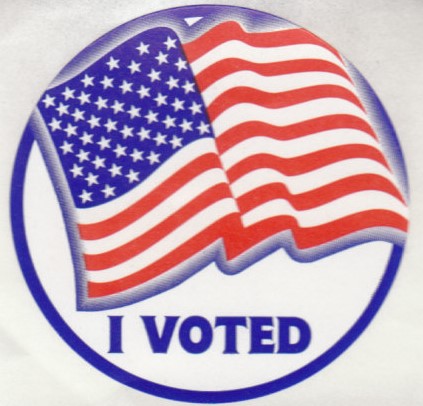
My sticker in 2019.

I cast my early ballot this week before Virginia’s Election Day on November 5. Virginia’s odd-year state elections often forecast the presidential election in the following year. Local candidates of different parties are very competitive to gain votes. This year in particular, thanks to the controversial Trump presidency, I saw the most campaign signs ever outside the polling station. They were in bright colors—orange, green, red and many more. The entranceway was festooned with a sea of colors.   

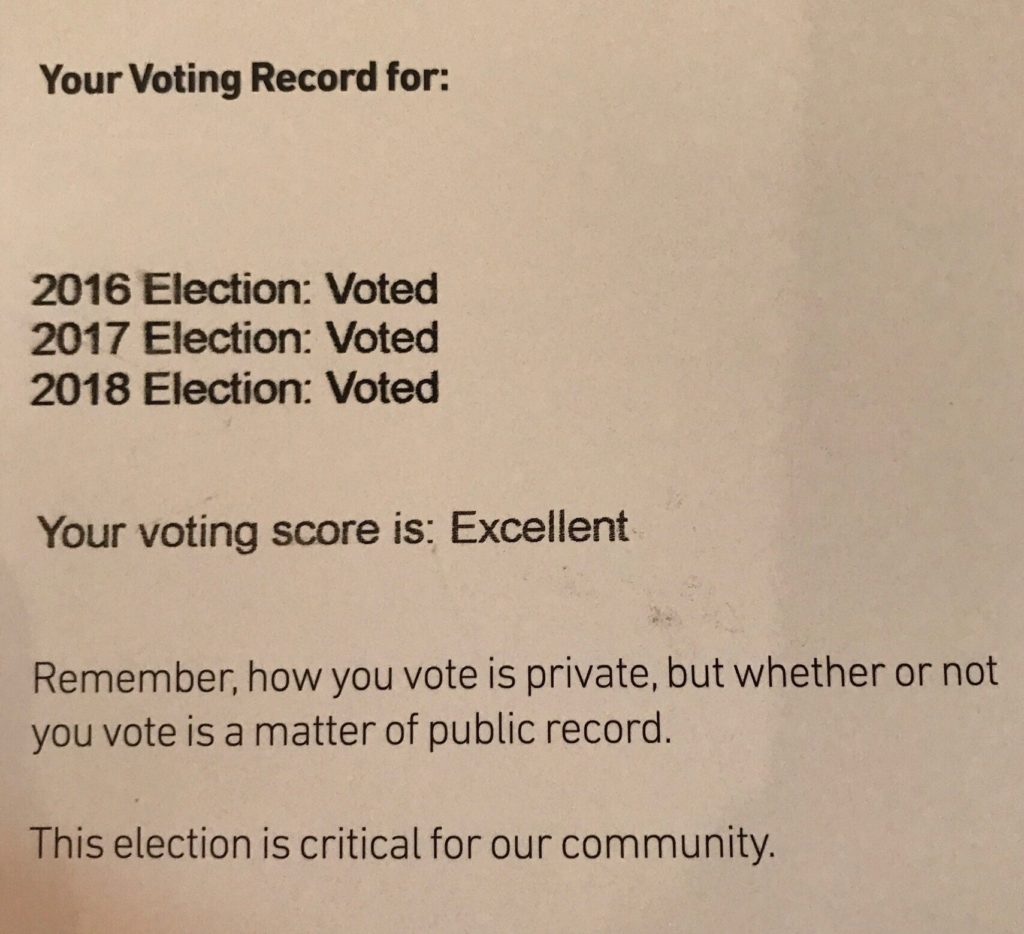
I was a little surprised that besides me, there were quite a few people in line at the polling station for their absentee votes. According to my voting record, this is my fourth consecutive year to vote, although in my vague memory I voted in 2015, too. Every time when I receive the sticker “I Voted!” from the polling station staff, I feel I am so American like I never have before.

I’d like to tell my family that I am a five-year-old American. But better than a five-year-old kid, I can vote because I meet the requirement of the minimum voting age of eighteen. Voting is a civic duty that I am proud of as an American. The Fourteenth Amendment to the US Constitution grants full citizenship rights, including voting rights. And the Fifteenth Amendment to the US Constitution eliminates racial barriers to voting. However, during my five-year’ citizenship life, I often hear news reports about voter discrimination. New voting restrictions are introduced in different parts of the country. According to a CNN report, discriminatory voter laws have surged in last five years with moves like closing polling places, cutting early voting, purging voter rolls and imposing voter ID laws. As an immigrant from China, I can relate to this discrimination sentiment.

Sometimes I question myself whether one will cherish her current life more after she has lived before in the have-not situation. I used to live in a rental home with my parents in China. So when I moved to an apartment that I helped finance it, I was extremely happy. In China, voting rights is not a strange word to educated nationals. Every Chinese citizen takes political science class as a mandatory subject in secondary education. Every student knows about his/her voting rights. But in reality, no adult Chinese has voted directly for their representatives and leaders. The closest direct vote I had in China was voting for the student cadres. Frankly speaking, our class president and other student cadres won the election fair and square. There are not many ordinary Chinese who know by name their officials except the top dogs.   

Now you understand why immigrants from countries that do not have democratic voting system value so much their voting rights in the US. I am one of them. My understanding of the US deepens, especially since President Trump took office. The rule of law, checks and balance and separation of power—these constitutional phrases used to be the answers that I memorized for my citizenship test; they are now constantly mentioned in the news media and in the lawmakers’ rhetoric associated with the Trump administration. Thanks to the truth-seeking journalists, I can learn about the American politics from their reporting on all sides of the matter—transparent journalism is something China cannot catch up with the US.

It doesn’t matter for whom you vote, but it matters if you don’t vote. Your vote speaks volume.    

Wanna say something to me? Click here and thanks!

My public record shows I have EXCELLENT voting score. Cheers to that!!

Family History

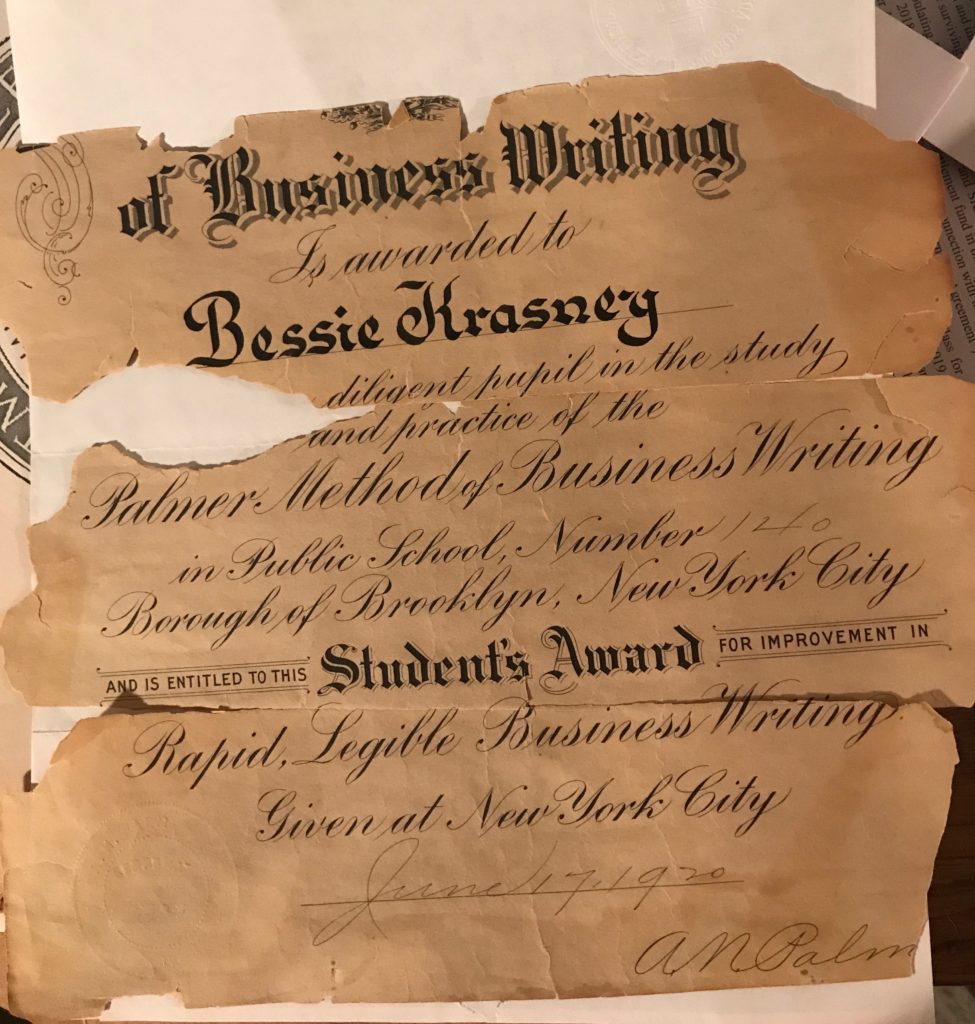
My American family recently discovered an old certificate dated back to 1920. It was an award certificate granted by a Brooklyn public school to the preteen Bessie, my never-met mother-in-law. The finding is not much a surprise to the family by blood. After all, other family members also keep some decades old files and photographs. But I was astonished when I held the yellow, crumbling broken pieces in my hand. I took the initiative to preserve them in one piece. Yes, just like a meticulous archivist. And I’m so proud of my little contribution to the family.

A piece of family artifact dated back to Jun 17, 1920,

In my Chinese upbringing, I saw old furniture and old wares that my grandparents used in their lifetime. In my memoir Golden Orchid, I mentioned that black wooden desk which was my paternal grandfather’s effect. My late father said it was the family treasure in their impoverished life. I wish I could keep that desk but I had to give it up eventually in my recent sale of my late father’s apartment. Keeping family artifacts takes time and space. Most of all, the collector must have a loving heart of preservation. In big cities like Guangzhou, people now live in apartments. It seems hard to store old artifacts at home. I’m probably the most nostalgic in my family and yet, I live the farthest. My Chinese family is not as nostalgic as many American families with which I am acquainted, including the one I married into. Perhaps antiques remind my Chinese family of the loss of the owner. Perhaps in China it’s so easy to replace old goods with the new. Whatever reason, Chinese people are not zealous to collect family antiques unless they have market value.     

I remember my late father used to tell me that during the Cultural Revolution, my paternal family had to burn the family registry to protect the family members from denouncement. Had we kept the family registry, I would be able to learn the genealogy about which the Japanese and the Americans fancy. In responding to the Communist Party’s campaign in the 1960s to destroy the Four Olds—Old Customs, Old Culture, Old Habits, and Old Ideas, countless historical evidence from the national level to personal use have been significantly destroyed and erased. It is a tragedy for Chinese future generations and even for the whole Chinese nation. Without the precious artifacts and records, historians cannot reconstruct fact-based historical accounts; our children and grandchildren will never know what happened in the past. Personally, I will never know my family stories. I am dying to know my family tree preceding my grandparents’ generation and even my grandparents’ untold stories.

When China condemns Japan for revising wartime history, I can’t help thinking—for centuries, didn’t Chinese rulers also dictate their own accounts of how history should be written? Burning books, destroying records, even killing the whistleblowers, these are the familiar plots used by ancient Chinese royals, and later were adopted in TV dramas. Now even such historical palace dramas that reflect power struggles are banned in mainland China. Because the authorities are in fear of “bad influence,” well, we all know the decision is more political than spiritual.

I may have gone off on a tangent. I just get sentimental when I see old stuff dated to the antebellum period in the US are still available in today’s yard sales and antique markets. Seeing collectors are telling stories vividly of the artifacts to their buyers, and now my American family members are actively talking about the history of that centennial old piece of family artifact, I lament the loss of my family history. As a matter of fact, tens of thousands of working class families like mine in China are told to believe what happened in the history from the perspective of the authoritarian government.

My standing ovation for Winston Churchill’s wisdom. He once said: “history is written by the victors.”  

I’m with you, Prime Minister.   

Bask in Nature

Here is a snippet of my personal essay “Bask in Nature”. For more, click here.

After traveling two dozen countries in my lifetime, I now understand why my well-traveled English penpal said people were alike around the world. I can’t agree more. In my latest trip to my birthplace, Guangzhou, China, I found the lifestyle is at the same pace with, if not more advanced than, the American lifestyle. Every service you can think of is at one’s fingertips—grocery shopping, car rental, bureaucratic errands, Chinese people are no strangers to e-commerce; as are American people. Tesla is doing very well in China, as are electric and hybrid autos. Let us not question what is the energy source of the electric cars. (Read more here) The public awareness of environmental protection is high in China, at least in the most developed coastal cities and the capital city Beijing. Plastic bags are banned in Guangzhou’s supermarkets; not yet in my American home Centreville. Paperless billings are common; a SMS reminds the users to check e-statements. I can still have print statements in America if I choose to. Mailboxes in China are for e-commerce goods. Junk mail is obsolete in Guangzhou’s residential postal mailboxes but omnipresent in my American home every day.

One of the major wastes I see, both happening in China and the US, is the packaging of online shopping products. On any given day, you’ll see piles of carton boxes and paper materials in the dumpster. Some of them look like new. Can we reuse these packages? Online shopping reduces human traffic to the stores but increases freight transportation and greenhouse gas emissions. Online shopping creates new jobs and yet destroys some traditional professions like shopkeepers, knock-on-your-door salespersons etc.

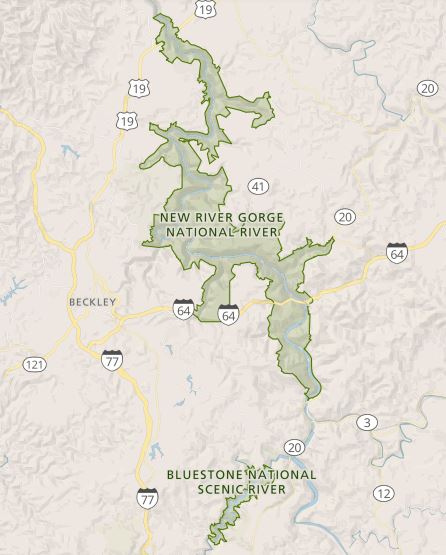
Basking in nature, I see the natural beauty, and yet our natural environment is vulnerable. The American chestnut is extinct in the Bluestone River Gorge after a wave of exotic pests and pathogens killed the native trees. But the blight-resistant Chinese chestnut thrives. Aha, Darwin’s survival of the fittest is in full play. Is the concept applicable to the ongoing US-China trade war, too?

Stay tuned for a day-to-day travel journal of my discovery in Cantonese culture and New Zealand landscape. Click here.    

Map courtesy of The National Park Service.

A Movie Buff’s Revelation

In my early days of learning English, I only knew the word “fan” to refer to a person who admires someone or something. Until one day my reading material introduced me to the word “buff”.  A native English speaker told me “buff” was a more colloquial and fancier word for the same meaning of “fan”.  In China, before the age of smart phones and touch screen devices, watching English movies is one of the few ways to learn spoken English. So I watched a lot of old pictures, ranging from Roman Holiday starring Gregory Peck and my favorite actress Audrey Hepburn, to The Sound of Music whose theme songs were indelible in my mind until today.

My late father remembered how I picked up English words from watching movies—I always carried a small notepad. I jotted down the phonetic sounds of the foreign word, despite my limited knowledge of English spelling at the age of 12. Thanks to the Opening Door Policy, mainland China was like a sponge at the turn of 20th century to accept Western pop culture. Adjacent to Hong Kong, the Pearl River Delta in the mainland’s Guangdong province had the advantage of receiving English TV programs from the former British colony. As a result, I watched these English movies on TV. After a movie was over, I would spend so much time with my dictionary in looking up those strange words in my notepad.

Going to the movie theater was a luxurious recreation for my working-class family. That was twenty years ago before the full introduction of 3D modern theaters nowadays in China. In my coming of age, if I went to movies in a theater, I went with a class to watch the patriotic or educational Chinese films under the supervision of our headmaster. I remember I watched a film about a young girl’s rehab life after a drug trafficking ring crackdown. Boy, no kidding that the educational film has cleansed my young mind so effectively that I have never smoked and detest smokers of all kinds. Until the passing of my father who was a chain smoker, I have gradually come to terms with myself to understand an addict.

My real exposure to Hollywood blockbusters on big screens was in my college years. By then 3D movies had drawn an increase of Chinese moviegoers. According to Wikipedia , China added about 8,035 screens in 2015, increasing its total by about 40% to around 31,627 screens. That was at a pace of 22 new screens per day on average. However, going to movies was still not cheap. The movie houses had been technologically upgraded, so had the ticket prices. I once watched an imported Western movie at 90 yuan (approx. US$12 in today’s currency). That was at least a decade ago. Now the cost is slightly higher. Back then, an average monthly salary for a clerk was about 2,500 yuan. So a ticket to a movie took up nearly 4% of the monthly salary. At that percentage rate, would you spend US$120 for a movie if your monthly salary is US$3,000?

I’m one of the Motion Picture generation. From TV cartoons to big screen movies, I’ve never said no to them. I grew up with them. My fondness for movies has become a necessity after I moved to the US. In my husband’s word, I’m an addict. I now begin to understand why the US diplomat I met in Guangzhou, China, years ago said that she missed the American movies the most when she was far away from home.

I was away from home for a month. During that month I missed movies the most. At home I watched movies on a weekly basis, sometimes double features in one day. I was disappointed that I had already seen the so-called latest movies on my international flights. And in China, imported movies (from the US, Japan, Korea and elsewhere) still need to go through a strict screening process to be shown in theaters. I should have watched more Chinese films while I was in China. But they lacked appeal to my Westernized mind. We hear about Chinese people being westernized, but I seldom hear about American people being sinoized or simply, “Hanized”, as Han Chinese is China’s largest ethnicity.

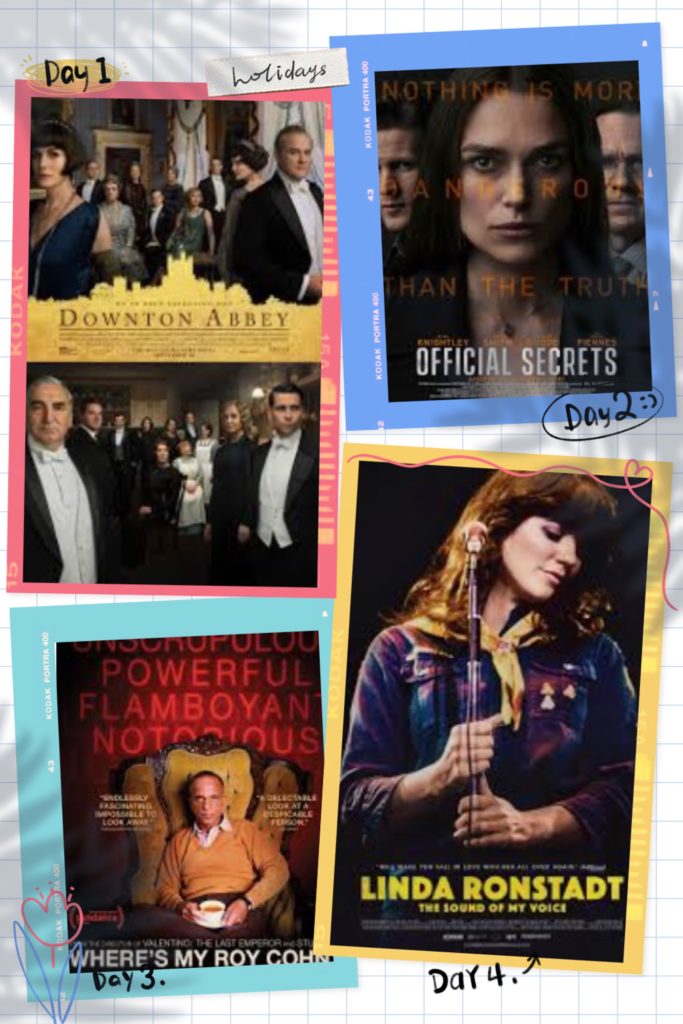
To quench my thirst for a month-long period of no movies, I went to watch four movies in a week upon my arrival to the States. Downtown Abby, Official Secrets, Where’s My Roy Cohn, Linda Ronstadt—two drama films and two documentaries. Watching movies now becomes my inspiration for writing. Instead of jotting down words I don’t know, I dissect the motion picture in my mind to learn about its storytelling. We are humans, regardless of nationalities and races. We are hungry for a good story; no matter if it is fiction or nonfiction. Cheers to movie makers and tens of thousands of movie buffs like me!!!

Leave a comment here.

A movie buff’s choice.

Finding Aotearoa

Aotearoa is the Maori name for New Zealand. It is pronounced a-o-tea-ro-a. The literal meaning of aotearoa is “land of the long white cloud”. Indeed, just like Maoris observed this land hundreds of years ago, the sky of New Zealand is often filled with white, long clouds—at least most of time during my visit. If I were the explorer of a new territory, I might even give the name “a rainbow country” to New Zealand. On one occasion, I saw rainbows three times in two days. I don’t see rainbow once in ten years in China, maybe a couple times in the US. So if you’re a gambler, you know betting on that bucket of gold under New Zealand’s rainbow are the short odds.

New Zealand is truly a land of pristine nature and an untouched world. The purity of water in this country is beyond my belief. According to our guide, he does not have water bills at all since he moved to Christchurch from China. Water is free for home use. That is not the case for Auckland residents, though. Water supply is abundant in this country. It rains quite often throughout the year. Nurtured by sufficient rainfalls, those green fields and home lawns just make any nature lover jealous. Not only can one drink directly the tap water, in the high mountains of New Zealand’s Southern Alps that I traveled, I sipped the running stream water. It was fresh and cold. My taste buds were suddenly awakened from the sweetness of mineral water.

If you have watched the movie series “The Lord of the Rings”, it would not be hard to imagine how breathtaking Aotearoa’s landscapes are. Many movie scenes were set in the home country of the film director Peter Jackson. He is a national hero of Aotearoa for he has made the country known to the world. And because of the success of the movies, New Zealand welcomes a tourism boom. In a small country without major heavy industries, tourism is New Zealand’s largest export industry in terms of foreign exchange earnings. It directly employs one in seven New Zealanders, according to the government website.

Long time ago I realized where there are Indians, there are Chinese. It is no surprise that Indians find home in Aotearoa because of the shared history of the two countries under British Empire’s ruling and the trading activities of the Dutch East India Company. Like Indians, Chinese are opportunity seekers in modern days. The fever of property speculation among Chinese middle and upper class has spread as far as New Zealand. According to my local sources, in the past fifteen years, building industry and housing market in New Zealand were doing “crazily well”. Who were the investors? The crazy rich Chinese. It was not uncommon that a Chinese buyer paid cash in full for a house. Oftentimes, a Chinese homeowner has more than one property under one name. I have no doubt that the White-dominated demographic makeup of Aotearoa will be overturned before long.

According to a report in 2014 from The South China Morning Post, China has become the largest source of new immigrants moving to New Zealand, overtaking the United Kingdom for the first time. Indian citizens rank third. That explains why Union Pay, Alipay (Jack Ma’s brainchild) and Tenpay (Jack Ma’s e-payments rivalry) are more omnipresent in New Zealand than in the United States. I could literally use RMB—China’s People’s Money—in souvenir shops and Chinese tourists-friendly restaurants during my stay in Aotearoa. Chinese buyers are always seen queueing outside Gucci Queen Street, Auckland.

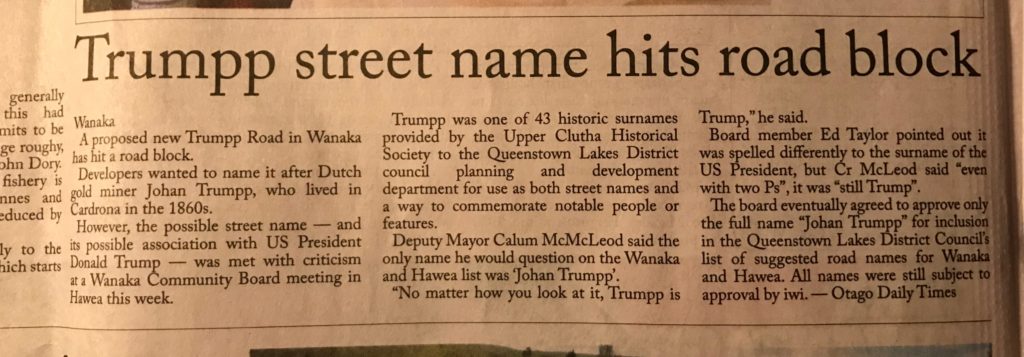
So again, echoing my previous entry about high priced pork, when the US under Trump administration is attempting to dump China as a trade partner, China finds other places around the globe to dump its RMB and authoritarian ideology. As far as Trump’s character, I was amused by this news story from a small coal mining town Greymouth in South Island, New Zealand. (See below image)

Greymouth Evening Star, September 28, 2019.

Bad news travels fast. I guess the crystal clear water in Aotearoa cannot purify Trump’s name. Alas, Trump’s linguistically innocent cousin Trumpp cannot escape from bad luck, either.

High Priced Pork

When I arrived in Guangzhou—my birth city in South China—last month, one of the first comments from my family was that pork prices had spiked greatly. Why? An epidemic of African swine fever has recently wiped out at least a third of all pigs in China. As the US-China trade war escalates, Chinese hog farmers bear the brunt of a shortage of soybean imports to feed the pigs. And it was on the eve of the Chinese Mid-Autumn Festival (Sep 13), a traditional holiday for Chinese families to get together for a dinner and to appreciate the roundest and brightest full moon at night. During the celebration of the Mid-Autumn Festival, demand for pork is higher than supply.

As I described in my memoir Golden Orchid, when it comes to celebratory meals and banquets in China, a dinner is not complete without chicken. Nevertheless, pork is more important than chicken in Chinese everyday diets. China is a country of pork eaters. In Mandarin Chinese, if you are asked whether you “chi rou,” it means, do you eat meat? Precisely, it means do you eat pork. When a Chinese housewife says, she needs to “mai rou,” buy meat, in the supermarket. She means she needs to buy pork.

Pigs were among the first animals domesticated for food in ancient China. So pork tops all choices of meat products on a Chinese menu. Unless you are among the Muslim minorities who consume no pork at all, but only the halal food. Or if you are a devout Buddhist, consuming beef is a taboo in your belief. When the meat of a dish is not specified, you can be almost certain that it is pork.

So during my visit in Guangzhou, the price of pork was about 30 yuan a kilogram, soaring nearly 50 percent. Many Cantonese families that I know have given up pork for the Mid-Autumn Festival reunion dinner. In fact, there are more food options in big cities today than a decade ago. Online grocery shopping is a trend in Guangzhou as well as in many other Chinese big cities. If you know how to use a smart phone to shop, you can basically sit at home to plan your dinner. Imported fruits, free-ranged chicken, deep-sea fish galore, everything you want to buy, or food that you never heard of, can be found on the e-commerce portal websites. So despite the high priced pork, Chinese urban dwellers seem to have an easy way out to find other cuisine substitute, and perhaps more nutritious and economical food items. 

To my amazement, grocery delivery in Guangzhou is very prompt. My uncle placed an online order in the morning, the shipment was delivered to the door in the afternoon. I think Amazon.com has a long way to catch up. After all, China has a domestic market of 1.4 billion people. The labor cost for one-day delivery is much lower than the same method being used in the US. Not to mention that a majority of Chinese people are now urbanized. The speed of urbanization in China is phenomenal, whereas the American population is widespread. Rural living is a dream for many in America but it is less appealing to the Chinese youths in China. One-day delivery is profitable and possible when great demand of services happen in a highly populated area. No wonder Amazon is investing tons of money on drone technology to replace human delivery.  

In an attempt to alleviate the high price of pork and its demand, Chinese authorities are now releasing meat from its frozen-pork reserves, an emergency facility created in the 1970s. China is also importing soybeans from Brazil, Argentina and other agricultural countries instead as usual from the US. So just like an old saying goes, when a door shuts, the other opens. In terms of international trade and global e-commerce, there are many doors for China to knock on, aren’t there?

Guangzhou is located 80 miles northwest of Hong Kong.

Trying My Patience at a Pop Concert

Sting at Wolf Trap, VA on Sep 26, 2019 (Mon)

Having attended a few pop concerts in America, I realize my good habit of being punctual is totally unnecessary. From Gwen Stefani to Christina Aguilera, from J-Lo to Sting, none of them showed up at their concerts on time as scheduled. The most procrastinating star in my experience is Gwen. Her performance was scheduled to start at 8PM. She didn’t come to the stage until after 10PM. At first I really thought she stood me up!

Instead, it’s a norm that the first hour of the concert or longer is slated for some unknown, or lesser known, singers and bands. They sing, dance, rap, scream, yell and even perform acrobatics on the stage. If you don’t like their music, too bad! You have to stick with it unless you put on your own soundproof gadget over your head. If you think you can get away from the loud music by just walking out of your seat, well, you’re wrong. The pulsating beat of the heavy disco music thumps the floor, shaking the building. I heard it even in the parking lot outside Gwen’s concert!

I often wonder if the sound engineers working for pop concerts are deaf, or near deaf. Only the deaf can’t distinguish that the sounds blasting from the amplifiers have become noises. In fact, sounds that reach 85 decibels(dB) are considered harmful for our hearing in the case of prolonged exposure. I certainly want my hearing back. But it takes a while to become accustomed to a quiet environment.

It seems it is a long time ago when a pop concert started on time. I was in Guangzhou, China. My more-than-a-decade-old concert experience there left me a good impression. That was in the age of pre-smart phones. Chinese fans brought their own handmade placards, and objects that glow in the dark to cheer for their idol. When they were motivated to sing along, clap, and wave their arms, the venue was lit up by a sea of sparkling crowd.

A decade later, the same interaction between the performer and the audience is still happening at concerts around the world. The only difference is the flashlight on a smart phone has replaced those glowing wristbands and bracelets. In the recent concert of J-Lo’s “It’s My Party Tour” in Washington, fans were requested several times to raise their illuminating flashlights on the phone. All of a sudden, thousands of white stars emerged from the pitch dark audience. They followed the command of the singer, “up—down—up—down—up—down . . . ”, the sea of stars twinkled, so many of them, in unison.

These heart-warming, rewarding moments perhaps are what we—the organizer and the audience—are waiting for the whole night. A small crowd cannot bring the melt-your-heart visual effect in full display. It needs a full house! This is show-biz! The more people come, the more drinks are likely to be sold during waiting periods for the star. For the late-comers, a pop concert is a perfect fit for you. Because we can’t start a pop concert until the room is full enough and the crowd is hyped-up. A Chinese proverb says it well: “It is easy to break a chopstick, but they become unbreakable when we put all of them together.” The more, the merrier.               

Now I will remind myself that if I want to skip the opening racket, it is ok to be late for a pop concert. However, I will be better off in the punctual world of classical music where the lights dim as scheduled and immediately followed by the sound of music from the stage. Salute to musicians of all genres! 

NOTE: Don’t forget to check out my book talk on TV. For details, click here. Due to my month-long travel, column writing will be suspended until mid-October. I will bring home more materials to share with you. Stay tuned!

Wanna say something to me? Click here and thanks!

The US-China Trade War—All Hell Breaks Loose

This is a big subject to talk about in my microblog. But I’ll do what I can to give you my two-cents.

What is tariff? Guanshui (关税) in Chinese. According to the Oxford Dictionary, it means a tax that is paid on goods coming into or going out of a country. As of the writing of this article, China will impose retaliation tariffs against about $75 billion worth of US goods, putting an extra 10% on top of existing rates in the US-China trade dispute. Motivated by hawkish advisors, US President Trump now demands—note, he demands, not requests, or simply suggests—US companies stop doing business with China.

Does that mean the Trump children will stop doing business with China to set a good example?

China is no longer the biggest creditor to the US. Japan has surpassed China since the past June after it increased its holdings of US bonds, bills and notes to US$1.12 trillion. So what it means is the US cannot blame China only for bad economical signs in the US. Trade itself is built on a bilateral relationships. If A disagrees to do business with B, B cannot strike a deal. It takes two to tango. Now Trump is DEMANDING that US companies stop doing business with China. This only pushes China to aggressively invest in other geopolitical regions, including in its homemade space project and Arctic expeditions.

When the world’s two giant economies are at one another’s throat, it only brings misery to the rest of the world. Because different political ideologies of the US and China will make their supporters take sides, the world will be split between an authoritarian camp and a so-called Western democratic camp. Even neutral like Singapore and Switzerland are, Chinese leadership see them too liberal to look up to.      

China, of course, has its own domestic economic problems. With the increase of an ageing population and the decline of the labor force in China, there’s a greater demand for health care and social welfare. But for those who have never learned about the history of the Chinese Communist Party (CPC), China is a country of self-reliance. The stronger the objections China receives from the outside world, the more resolute China, or precisely speaking, the Chinese one-party leadership, will become. They believe the country can find its own way to overcome adversities. The monumental leap of Chinese space program in recent years is proof after Chinese astronauts were snubbed by the International Space Station. 

A step further back in history—more than half a century ago when relations between the Soviet Union and China ruptured over the future of communism, China tightened central government control, and launched a series of new programs to revive domestic economy without its big ally’s help. According to Britannica.com, under Mao’s leadership, in 1965 China regained the level of output of 1957—the year before the Great Leap Forward campaign—in almost all sectors.

So when China is aggressively strengthening its image and influence in Africa, the South Pacific, and even in the backyard of the US—the Latin American countries, the US needs to understand that cooperation with China is the only way to maintain peace in all global regions politically, and economically. China won’t collapse because of the US’s retaliation in trade, which it naively thinks will stop China’s antagonistic behavior. Instead, China’s belligerent attitude will flourish. In the CPC lexicon, let’s boycott US goods and all people will stand up stronger against the bully.

You’ll all agree that Trump is the “gold standard” of a bully, right?

Wanna say something to me? Click here and thanks!