One of my biggest accomplishments in 2025 was my first trip to Prague, Czech Republic. I decided to spend Christmas with my family there while exploring the UNESCO World Heritage site, where centuries of history meet festive Christmas magic. During my weeklong stay, I walked every day, sometimes braving the frigid winter for an hour while waiting to enter popular attractions. The wait was worthy though—here are some snippets from my trip.
Walking Through Centuries of Architectural Wonder
I had the honor of visiting the French Ambassador’s residence in Prague, a 17th-century historic building formerly owned by the Buquoy family. The Buquoy family was a notable family of French origin, whose influence became firmly established in Bohemia (today’s Czech Republic) and extended into the Austrian lands of the Habsburg monarchy. In 1918, Prague became the capital of the newly established Czechoslovakia, and France was among the key supporters of its independence. The French government initially rented the Buquoy Palace in the early 20th century and later purchased the property in 1930. My host, the Honorable Ambassador Stéphane Crouzat, showed me around the first two floors, which house the official rooms. From the grand staircase in the entrance hall to the color-named rooms, the décor and antique furniture dazzled me. I felt as if I were touring a mini Versailles. Tiers of chandeliers looked like inverted sparkling cakes adorned with crystal. Guided by my late father’s influence, I was thrilled to recognize several pieces of Oriental porcelain that may have once traded by the East India Company. The music room with the spacious elegance of a ballroom enchanted me at first sight. In one corner stood a towering Christmas tree adorned with colorful balls and glowing yellow lights. Two vivid tapestries from late 17th-century Beauvais hung on the walls, adding a sense of history and grandeur. Across from the Christmas tree, in the opposite corner of the room, a 1926 Pleyel piano drew the eye and captivated the ear—not only with its elegant appearance, but with its rich and resonant sound.
One evening during my stay, accompanied by my host, I wandered through the 19th century garden visible from my bedroom window. This garden quickly mesmerized me with its perfect geometry and sense of order—a rectangular lawn, neatly pruned trees (some of them are pear trees) and tiered flowerbeds that embodied the symmetry and discipline of the Baroque style. Strolling there on a chilly winter night added a touch of mystery. Together with a few evergreens, the tall and bare deciduous trees stood like silent sentinels, their naked branches reaching skyward as if issuing a gentle warning: We’re watching you. Behave. I paused to gaze at them. I wanted to offer them an honorable salute of admiration: “Thank you for guarding this noble Prague estate.” A plaque at the entrance to the garden credits a predecessor resident, former Ambassador Alexis Dutertre, with renovating the garden access. The estate underwent extensive restoration between 2021 and 2023, the official rooms, the garden entrance, and the garden itself were all thoughtfully renewed. The scale of the work sparked my curiosity about what it takes to restore a historic site—from construction logistics and design choices to the costs contractors must navigate.
This is Prague. Friedrich Nietzsche once said, “When I sought for a word to express mystery, only Prague came to mind.” I knew little about Prague except for its world-renowned astronomical clock, which mounted on the southern wall of the Old Town Hall in the Old Square. First installed in 1410, the oldest medieval clock is still in operation today. More than a decade ago, when I was an editor in China, I wrote a travel-column feature about Prague for a teen magazine. Since then, I had longed to visit the attractions in Prague. My dream finally came true at Christmastime 2025. My host Jenny wasted no time. After lunch, she took me for a walk through the Old Town. We crossed the Vltava River on Legion Bridge, and from there we glimpsed Charles Bridge in the distance. The old stone bridge was built by King Charles IV in the 14th century to replace a bridge washed away by floods. For centuries, Charles Bridge was Prague’s only crossing over the Vltava River, connecting Old Town and Prague Castle for knights and traders. Today, eighteen bridges span the river within the city, creating an eclectic timeline of the city’s evolving architecture.
Prague is an ideal place to study the architectural history of the West. I was captivated by every building’s exterior style and history, just as much as by its interior design. From Gothic to Renaissance, from Baroque to Cubism, I felt like a child chasing thousands of fireflies through the open air at night. I started walking in early morning every day, hoping to capture these images with my camera before seemingly endless stream of tourists descended upon the ancient city. Daylight in Prague’s winter is fleeting, and capturing its light is as time-sensitive as photographing the intricate façades of its architecture before a wandering pedestrian inadvertently steps into the frame.
If you enjoy visiting Paris’s Notre Dame, you won’t be disappointed by Prague, often called the “City of a Hundred Spires.” In fact, the city is estimated to have more than one thousand spires, ranging from Gothic and Baroque to Renaissance and other historic styles, crowning its churches, towers and buildings. During my trip, I visited several remarkable basilicas, including Strahov Monastery for Christmas Day Mass, Saints Peter and Paul Basilica and St. Vitus Cathedral. Every time I entered a large historical church, I was struck speechless by the intricate layers of portal archway, the lofty ceilings with ribbed vaults, sparkling stained-glass windows and elaborate frescoes. The giant, gleaming organ on the upper level took my breath away. Within the vast nave, its sound seemed to grow louder, echoing endlessly, reaching deep into each listener’s soul with melodic hymns to God.
What enriched my understanding of historical churches on this trip was observing the architectural styles: Romanesque, Baroque and neo-Gothic elements were all present in these places of worship. No wonder that pilgrims in the past were drawn to churches—not only to participate in religious rituals, but to marvel at the masterpieces that showcased human craftsmanship inspired by divine inspiration. I wonder if our obsession with convenience and immediacy—driven by the endless interruptions of machine learning and automation—will in fact push humanity toward a decline, even extinction, of true craftsmanship. Real hands-on mastery lies in persistence, patience and the pure pursuit of beauty through trial and error. In Prague, I was able to see specialty shops devoted to bakeries, hats, shoes, books, perfumes and even traditional puppets. Another eye-catching sight around tourist hubs was the surprising number of weed shops. You might assume Prague is as weed-friendly as Amsterdam, but several sources debunk that myth. Cannabis sales are quite restricted in Prague. Still, window shopping through the city was a delight. I become acquainted with the finest handmade artworks displayed in the decorated windows. By contrast, in the U.S. and China, people have long grown accustomed to the one-stop shopping—whether online or in sprawling malls. How can we ensure that traditional craft knowledge and expertise are preserved and passed down to future generations?
I’m High On A Hill
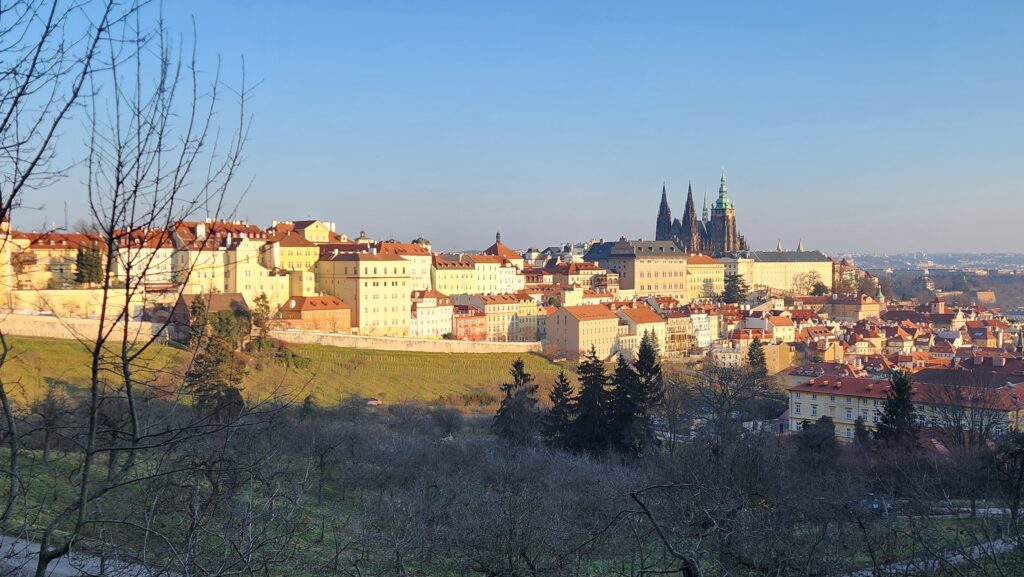
I’m high on a hill, looking out over Prague. Only when you stand above the city do you fully grasp its geographic and military advantages as well as the timeless charm of this old place. During my visit to Prague, I had a couple of hiking opportunities. Several overlooks offer breathtaking panoramic views of the spires and the city’s red roofs, including Petřín Hill, Prague Castle, the Vyšehrad Fortress and Letná Park. On my way to Vyšehrad Fortress, I crossed the river over Jirásek Bridge—the closest bridge to the 20th century deconstructive architecture of the Dancing House. I was enthralled by the awkward shape of the seven-story commercial building, where glass and concrete twist in defiance of Prague’s medieval silhouettes. Nicknamed “Fred and Ginger” to reflect a dancing couple, the Dancing House stirred in me a nostalgic longing for classic American films.
At a high vantage point, I gazed down at a vibrant city with a glistening ribbon of river flowing through its center. Each bridge was like a chain link, connecting the flow of trams, cars, bikes and pedestrians in the city’s living narrative. I could hear clearly the hustle and bustle of the city below, the swirling December wind, the church bells ringing in a rhythm that lingered longer than I had ever noticed, the rushing river flowing past several medieval mills, birds chirping and the faint whispers of other hikers. As a foreigner in this city, born and raised in Far East, I felt my entire perception of Central Europe suddenly awaken over these few days, colliding and mingling with what I had known about the region while my sense of connection to it grew stronger with each passing day.
A short stroll from the fortress walls brought me to the Basilica of Saints Peter and Paul, nestled within the historic Vyšehrad complex in Prague. The original Romanesque church was damaged by a fire in the 13th century and rebuilt in neo-Gothic style. Its twin spires pierced the skyline, seemingly even taller atop the rocky hill. Just beyond the basilica lay the Vyšehrad Cemetery, where famous Czechs were buried. Some of the old tombstones were elaborately decorated and richly ornate. I had a booklet that introduced the notable figures buried there, including František Ladislav Rieger(politician), Antonín Dvořák (composer), Karel Čapek (writer), Jan Neruda (poet) and many others.
Two landmarks located at these high points especially caught my attention: the Eiffel Tower of Prague and the Prague Metronome. I found them striking and memorable, and I learned more about their history after my trip than I did while I was there. The Eiffel Tower of Prague—officially called the Petřín Lookout Tower—was inspired by the Eiffel Tower in Paris and was built in 1891 for Prague’s Jubilee Exhibition, which celebrated industry, science and arts. The other city landmark is the Prague Metronome, a giant working device in Letná Park. It stands on the site where a massive statue of Joseph Stalin once stood before it was dismantled in 1962. Installed in 1991, the metronome serves as a symbol of the passage of time and political change.
Never Too Old To Learn
As I told my host Jenny, I loved museum hopping—my personal record was visiting four museums in a single day. More often than not, I left each visit with more questions than answers. As Socrates famously said, “The more I know, the more I realize I don’t know,” and I felt that deeply. These are the museums where I left my footprint—places I would gladly revisit in the future:
- Museum of Decorative Arts—A rich collection featuring French interwar advertising posters alongside a permanent exhibition tracing “art for life” from the Middle Ages to the 21st century. I explored objects for rituals, furniture, glasswork, jewels, curiosities, modern décor and fashion.
- Rudolfinum Gallery—a contemporary Czech artist, Kateřina Vincourová, had an exhibition there during my visit. Her large-scale installations were beyond my comprehension until I read the English booklet after the trip. Apparently, I’m a rather dim viewer!
- Klementinum Astronomical Tower and Baroque Library—a must-see in the Old Town. There, I learned a lot about the history of Western astronomy and the legacy of Jesuit missionaries. Inside the tower, portraits of four legendary astronomers—Tycho Brahe, Johannes Kepler, Nicholaus Copernicus, Galileo Galilei—adorned the walls, honoring the giants whose work shaped our view of the cosmos. Don’t miss the 360-degree view of the Old Town from the top of the tower! I had an amusing experience even before entering the building. Tourists from all over had started lining up before nine o’clock opening. A family of three tried to cut in ahead of me, but I stopped them on the spot, earning approving nods and cheers from the people behind me and a staff member monitoring the line. That’s the importance of speaking up, isn’t it?
- The National Museum—this place is immense: history buff could easily spend a few days exploring every detail. I went there to learn about regional history and happened upon a temporary China-themed exhibition that had run until the end of last year. Titled “100 Treasures, 100 Stories,” it showcased rare imperial collections of the National Palace Museum in Taiwan. The famous jade sculpture “Cabbage with Locust and Grasshopper” looked smaller in person than in print. I was thrilled to see this treasure without traveling to Taiwan—an experience like seeing the Mona Lisa outside of Louvre.
- Franz Kafka Museum—I actually learned more about Kafka at a small house, Number 22, on Prague’s Golden Lane inside Prague Castle than from this dark confined space named after the author. I found the explanatory texts difficult to read in poor lighting and on transparent surfaces. One author who caught my eye was Max Brod, a close friend of Kafka. Brod wrote extensively, yet he was lesser known than Kafka. Kafka’s fame, largely posthumous, may have surpassed his recognition during his lifetime. According to the museum biography, Kafka was extremely critical of his own work and published very little. The majority of his work, which later brought him worldwide fame, “was only published thanks to his closest friend Max Brod, who did not respect Kafka’s wish to mercilessly burn the manuscripts.” The sculpture Piss by Czech sculptor David Černý—a bronze fountain of two men urinating into a lake shaped like the Czech Republic—seemed oddly out of place in front of a museum dedicated to a Czech literary icon.
- Czech Museum of Music—a one-of-a-kind museum dedicated to historical instruments and music history collections. I later found that the site was once the Baroque Church of St. Mary Magdalene, built in the 17th century. I was just a handshake away from a fortepiano that Mozart played in Prague in 1787. My heart nearly skipped a beat! I also loved this little anecdote about Mozart’s impression of Prague: in a letter to his father, Mozart wrote the applause was “more intense than in Vienna” and he was marveled at the audience’s knowledge and enthusiasm. Standing there, I could feel the pride of Prague’s people too. The museum’s temporary exhibition focused on the legendary Czech opera singer Soňa Červená, who passed away on May 7, 2023. Marking what would have been her 100th birthday in 2025, the exhibition transported visitors back in time through archival photographs as well as audio and video recordings, revealing not only the opera singer’s life on stage but also her offstage life unfolding against the backdrop of Czech political turbulence.
- Prague Castle Picture Gallery—Inside the vast Prague Castle complex is the Picture Gallery, one of the oldest continuous art collections in Czechia. The gallery displays around 100 finest paintings and sculptures drawn from the castle’s 4,000 artworks. These masterpieces by major European artists such as Rubens and Titian dated from the 15th to the 18th centuries, among which a small portion came from Emperor Rudolf II’s original collections. Under dim lighting in some corners, it might demand extra effort for the eyes to study the expressive figures and dramatic compositions in the old paintings, whose pigments have turned darker over time. I enjoyed resting on the comfortable cushioned bench in the center of the room while gazing at the artworks at a farther distance.
- Trade Fair Palace—If the National Museum in Prague takes days to absorb in full, you might plan on doubling that time here at the largest gallery site of the National Gallery Prague. From František Kupka and Emil Filla to Pablo Picasso and Henri Rousseau, I spent time in close proximity to their works, as if transported through time and space into the very setting depicted in the artworks. This surreal sensation of intimacy left a deep impression on me. My admiration for these masters of the late 18th through 20th century—not only from Czechia but also from Europe, especially from France—grew from a smoldering ember into a fire within me. Inside this rectangular, eight-story building formed around a central atrium with windows shaded to soften the light from outside, I lost track of time especially with Prague’s short winter daylight. After about four pm, night seemed to be closing in. Set near former factories and industrial grounds, Trade Fair Palace was Prague’s first Functionalist building in early 20th century, originally designed as a trade exhibition hall.
The most challenging part of my learning experience in Prague was immersing myself in Josefov, the Jewish Quarter. Physically I was ready, and yet emotionally I was not. Judaism was a myth to me, and in Prague, Jewish subjects fascinated me. Pressed for time, I brought a ticket that enabled me to visit four synagogues and the Old Jewish Cemetery. It was Christmas Day, and my phone navigation was suddenly out of whack—the phone was my lifeline during the trip. Without GPS, I felt abruptly unmoored as if a blind without her walking stick. Questions crowded my mind: How to get to Maisel Synagogue? Where is the Spanish Synagogue? What’s worse, people around me spoke every language except English, and the street signs were not helping—either in Hebrew or in Czech. A jolt of fear surged through me—Without my GPS, how should I get home? I asked myself after failing in my attempts to restart my phone and reset my data. I had to cut short my tour in the Jewish Quarter and rely on memory alone to find my way home. In the end, I managed to visit only the Old-New Synagogue and Klausen Synagogue. The Old-New Synagogue is the city’s oldest synagogue, which has survived fires and Nazi destruction since its completion in 1270. Klausen Synagogue, which was the largest synagogue of the Prague Jewish community, stood beside the Old Jewish Cemetery. The cemetery looks crowded and uneven today, resulting from layers of bodies stacked in the same plot of land for over 300 years. What a striking contrast to the Vyšehrad Cemetery!
My search for the path home guided only by memory was exciting and unsettling. Prague’s Malá Strana is a maze of narrow, winding cobblestone streets. The city’s mystical atmosphere and richly symbolic landscape have long inspired writers and filmmakers to set their scenes here, including Dan Brown’s latest work, The Secret of Secrets. My destination was near the peaceful Kampa Park, which offered photo-ready views of Charles Bridge. The Lennon Wall—a symbol of peace and free expression—stood directly across from the French Ambassy. My previous visit to Franz Kafka Museum and Shakespeare and Sons Bookstore also served as important clues in helping me find my way home. Suddenly, I felt as if I had become a character alongside Brown’s protagonist, Professor Robert Langdon, searching for clues in this mystical city. Fortunately, my puzzle proved far less challenging than those faced by Brown’s fictional hero. I eventually arrived home without GPS navigation—How marvelous!
Joy to the World from Prague
Before I arrived in Prague, several friends and acquaintances had recommended that I visit the Christmas Market. I soon discovered that it wasn’t just one market, but several scattered across the city during the holiday season. The most famous was in Old Town Square, surrounded by iconic landmarks such as Old Town Hall, the medieval astronomical clock, the 14th-century Týn Church with its twin Gothic spires, and Jan Hus Memorial. Enveloped by seas of people, dazzling holiday lights, the laughter and cheers of visitors, Christmas carols, and the aromas drifted from market stalls, I could hardly imagine that Old Town Square had once been a place for public gatherings, punishments and executions in medieval times. I was dwarfed by the eight-story high Christmas tree towering in the square. I was traveling alone but I did not feel lonely. I enjoyed people watching and Prague made it easy for me to watch people from all over the world. Among the crowd, I could distinguish at least eight different languages being spoken.
Aside from street foods sold at Christmas Market like Trdelník (a cylindrical pastry rolled in sugar and cinnamon and topped with ice cream), ginger bread, mulled wine and roasted ham, experiencing Prague at Christmas wouldn’t be complete without a traditional festive dinner. Traditional Czech Christmas cuisine includes fried carp, potato salad and mulled wine. I once believed that only Chinese people considered eating a whole fish from head to tail a true delicacy. But no, Czech people do too. In Prague, I saw locals outside a mall buying live carp from temporary fish stands set up across the city. Fishmongers kept the carp in large tubs of circulating water; on the other side, on a blood-stained cutting board, lay freshly cut fish parts. Watching the buyer and seller converse in Czech, as if exchanging precise instructions on how to cut the fish, I felt transported back to my childhood visits to Cantonese wet markets, where live fish were slaughtered in full view. Had I stayed longer in Prague, I would have brought a live carp to cook myself.
On this trip, I didn’t have the chance to taste Czech carp. I did, however, sample the mulled wine. Locals call it svařák, a word I soon recognized on countless signs at the Christmas markets. Served warm and infused with citrus and spices, the wine was comforting and fragrant especially for outdoor gatherings in chilly winter. I skipped adding sugar, though I was told many locals prefer it sweetened with sugar or honey. And speaking of alcoholic drinks, I also found myself craving Czech pilsner, brilliantly clear with a crown of creamy white foam. Its smooth body and gentle bitterness invited more sips, making it the perfect companion to Czech pork knuckle. The portion was large enough for three people. With its crispy skin and tender meat, the dish was so satisfying that it left an unforgettable impression on me.
On Christmas Eve, I was honored to be seated with my host and their children to appreciate the one-of-a-kind Franco-Polish Christmas dinner. My host has Polish roots and the traditional feast on Christmas Eve is called Wigilia. I later learned that Wigilia is a meatless feast held after the first star appears, featuring twelve dishes symbolizing the Apostles. Celebrating both French and Polish Christmas traditions, my host family prepared a scrumptious twelve-dish feast—Polish meatless classics alongside French seafood freshly shipped from Brittany. I prompted documented the menu to indulge my lifelong fondness for the c’est la vie lifestyle.
- Barszcz Czerwony (aka Borscht beet soup)
- Oysters and shrimps with mayonnaise
- Breton lobster bisque
- Bigos and Pierogi
- Monkfish tail au four (baked) with potatoes and oyster mushroom sauce
- Scallops with their coral (aka coral scallop)
- Mak (aka poppy seeds)
- Compote
- Panettone
- Chocolates
- Crémant d’Alsace Joseph Cattin
- Sedlák Chardonnay 2022
We spent half a day cooking in a grand kitchen that serves state dinners for Embassy dignitaries. The vast space and top-tier equipment made cooking feel unexpectedly effortless and delightful, even when I helped with the dishes and wrapped a few pierogi. I wonder if this embassy-kitchen experience might earn me a few bonus points on my next job application.
The most anticipated moment had arrived—dinner was ready. We exchanged wishes and clinked our glasses to toast before diving into the twelve dishes. They were colorful: reddish-purple beat soup, gray and white oysters, orange bigo stew, pale yellow perogi and a green homemade sauce paired with coral scallops. Plates were passed around so everyone could savor each dish.
One thing was missing from the menu, however, was my new favorite French tradition—Brûle de Noël, literally “Christmas log.” It was a cake shaped like a Yule log, decorated with branches, cinnamon sticks and red cherries. Its texture was soft and its gentle sweetness melted in my mouth like delicate cotton. After dinner, we gathered in the music room to sing Christmas songs around a 1926 Pleyel grand piano. Standing beside the one-hundred-year-old instrument, I was reminded of two nights earlier when I had stood next to an upright piano in a local pub, listening to a live performance of “Rybovka,” the famous Czech Christmas Mass named after its composer, Jakub Jan Ryba.
An hour before the performance, the pub was already packed with joyful crowds—mostly locals—and I was probably the only Asian in the room. The low ceiling confined the noise, making it feel louder. A sip of chilled pilsner helped cool my body as the room warmed from people squeezing in shoulder to shoulder, a sharp contrast to the outside air hovering just above freezing. When the music began, the chatter dissolved into silence. A small choir of twenty, accompanied by local musicians of a dozen, performed with remarkable passion and coordination. It was my first time truly appreciating a live concert in a pub. From my perfect vantage point, I could watch the different parts of the sound work together in harmony.
“Hej, mistře, vstaň bystře, vzhlédni na jasnost. . .” A short and declamatory tenor voice burst out to my right, no more than an arm’s length away, followed by the piano keys pounded beside me, their resonance vibrating through the wooden floor and into my eardrums like a waterfall of sound you never want to end. The bespectacled pianist, who also served as a conductor, rose and played as if the melody had possessed him, each groove and beat etched into his movements. His hands flew across the keys while his head bobbed, beads of sweat glinting under the pub’s yellow lights. The music spilled into every corner of the intimate pub, stirring emotions that played vividly across the pianist’s expressive face. I was captivated by the sheer power of performance. Despite the language barrier in the lyrics, I could sense the glory and love the choir was praising through its chants.
That same transporting sensation was how I felt in the music room with my host family on Christmas Eve, where we sang Christmas carols in English, Polish and French. The joy and hope of the holiday spirit are universal. Earlier, a local Czech artist had told me that Prague was once home to Czechs, Germans and Jews, but the cultural diversity largely vanished after World War II. A similar transformation occurred in religion: Christianity, particularly Catholicism, once shaped everyday life, yet today Prague is often described as one of the most secular places in Europe.
During my visit, I encountered Prague as a living remnant of humanity’s layered history and preserved culture, standing in stark contrast to the mercenary modernism that dominates superpowers like China and the United States. This makes the mission of preserving Prague as a UNESCO World Heritage site feel even more urgent, especially in an era when augmented reality is becoming increasingly common in museums and retail spaces. Would you travel to Prague to experience the past or rely on synthetic media that recreates the voices and images of those who have long passed to tell the story of our civilization? As historical simulations are increasingly shaped by commercial interests, how can we not reconsider the ways we interpret and value cultures once lost? Prague reminds me why we care for history, for music, for art, for holiday traditions, and ultimately for the soul of humanity itself.