Blue Recovery

As Arthur C. Clarke has observed: ‘How inappropriate to call this planet Earth, when clearly it is ocean.’ Nearly three-quarters of the Earth’s surface is sea. . .

—James Lovelock

A year ago I wrote a piece titled “Ocean Love” while I was fascinated by the international Blue Carbon Initiative in my grad school study about sustainable development. A year later, as I read this piece again after a road trip to the Atlantic Ocean, I have more faith in the blue recovery than before. Simply because we human beings can’t survive without healthy oceans. Nevertheless, the oceans of the Earth can exist without us.  

The ocean plays a leading role in the Earth’s climate. Warm ocean waters provide the energy to fuel storm systems that provide fresh water vital to all living things. In grade school geography, I’ve learned that about three quarters of the Earth is water, leaving only one quarter as land. Given the fact that our shorelines around the globe are eroding fast and furious and ocean acidification resulting from the burning of fossil fuels is threatening marine biodiversity and our food security, does this ratio still stand today?

The blue recovery, or the blue economy if you’d prefer the World Bank’s term, that aims to restore marine ecosystems and promote the sustainable use of ocean resources is a financial leverage to turn adverse effects of climate change into long-term benefits. For some years both the U.S. and China have boasted their own “blue Silicon Valley”—in Monterey Bay, California and Qingdao, Shandong—dedicated to driving innovation in the two superpowers’ blue economies. In other words, on land we need green recovery; at sea we also need blue recovery. I second Michel Serres, a French philosopher and mathematician’s viewpoint that climate change is an economic issue. Climate action can be viewed as an economic action that requires global standardization with diversity and inclusion in mind.

Taking a layman’s look into China’s green finance policies from renewable energy projects and water treatment plants to waste management facilities and the newly-launched national carbon trading scheme, we cannot disagree that these initiatives are public-private partnership efforts to promote long-term growth, precisely, the economic activities of sustainable development.

Action speaks louder than words. I still remember this line in the script of my undergrad speech contest. Regardless of the effectiveness of these economic actions taken place in China—some may still be in the beta stage while others may have impressed the world, I haven’t seen other emerging markets that might test the waters of green finance have aroused quake-shaking attention to the developed countries like China has.

If China was not the world’s most populous country and one of the world’s top five largest countries in total area, do you think China’s economic development would have as much global impact? The size of a country is like the size of a person. For a small person, he or she has a disadvantage to impress their love interests and future employers in many cultures. Big-size countries tend to have bigger say in global affairs and even get “excused” for not following international rules. For instance, Russia is illegally occupying Ukraine’s Crimea, the U.S. is closing an illegal 20-year war in Afghanistan, and China’s key role in recycling the world’s electronic waste is now shifting to low-income developing countries such as Ghana and Bangladesh. China’s foreign investment includes building coal-fired power plants and exploiting natural resources abroad. Poor countries with unstable governments such as Laos and South Sudan perhaps will never recover from the loss of biodiversity and deforestation. Can poor countries say no to foreign money if they have to monetize natural resources and wildlife excessively?

If history is a lesson for humanity, I can see that humans are taking resources from Mother Nature faster than she can conserve or replace them. With the help of new technologies, humans can exploit natural resources faster in greater amounts. Can we switch the gear to slow down our pace of consumption? Can we manage our nonrenewable resources like we do with our retirement benefits? Can we let Mother Nature take a break from time to time without asking so much from her for providing us goods and services? Can you start from today to reduce, reuse and recycle? Our favorite Sir David Attenborough has narrated the timely documentary film “The Year Earth Changed” about how wildlife responded to a year of global lockdown of 2020.  

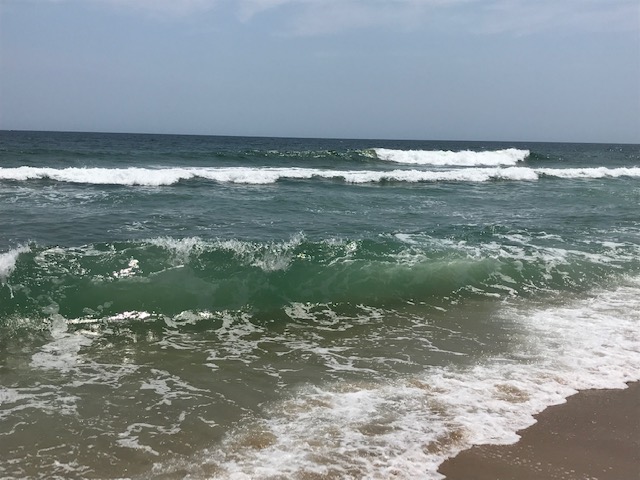
Many of us who don’t live or work by the sea may think very little about how life-threatening marine litter is to our survival until the time for summer vacation comes or our favorite seafood is sold at a higher price due to scarcity. This summer when I revisited the Atlantic Ocean, I noticed the shoreline had changed. Higher sand dunes were built as a measure to reduce erosion and damage of coastal homes and facilities. I couldn’t find as many of the big seashells as I used to. The sand was so scorching hot that I had to put on my flip-flops instead of walking barefoot when I walk on it.        

Marine litter reminds me of a new phrase I learn from reading Donovan Hohn’s investigative nonfiction book “Moby-Duck.” The word is “garbage patches,” meaning the convergence zones in the ocean where currents converge and spiral inward, collecting what’s floating on the surface. Hohn’s book which was published a decade ago revisited an even older environmental case. A massive container ship mishap in 1992 led to 28,000 plastic bath toys lost at sea. The plague of plastic in the ocean is not a new example of humans impact on the environment. In fact, according to marine scientists, one can see concentrated marine debris, mostly plastic, in the most famous garbage patch located in the North Pacific Gyre between Hawaii and California.

Well, are human beings one of, if not the most, polluting living creatures on earth? On land we have unsustainable amounts of electronic waste, at sea we have marine debris, and even in space we have space debris. In economics, there is a central principle called “fungibility,” meaning the ability of a good or asset to be interchanged with other individual goods or assets of the same type. That’s to say, if I can’t get a chocolate ice-cream, I can still get a strawberry one. The powerful Google search engine can provide many alternatives under the keyword “smoking substitutes.” So, with the help of new technologies, if marine debris can become a valuable commodity like a pirate’s treasure chest, will there be more daredevils set sail to these garbage patches? Do not complain we need more data. We’ve already known about how detrimental marine litter is to our food security and marine biodiversity. Can we start from today to stop leaving garbage behind after our seaside vacation? Most important, can we design a mechanism similar to a carbon trading scheme to reinvest and reuse the plastic marine debris?

We often hear the wish that if the big member states of the United Nations can work together on the basis of human and wildlife coexistence to deal with sustainable development issues, small countries like Kiribati in the same grouping of “Vulnerable Member States of the United Nations” will have a fair chance of not only making ends meet but leapfrogging with the help of new technologies into a sustainable economy.

And while these elephant member states are flexing their muscles to decide other small countries’ fate, nature-based solutions to climate change—these are low-cost, big-return investments—will help every community, especially the underserved and vulnerable people to buy time. Above all, if our mind is set to do good deeds for Mother Nature, starting from today you can change your lifestyle to live more healthily and happily. Facing the dual crises—the Covid pandemic and climate change, we all need to be a combat optimist, no?

The Earth existed without our unimaginable ancestors, could well exist today without us, will exist tomorrow or later still, without any of our possible descendants, whereas we cannot exist without it. Thus we must indeed place things in the center and us at the periphery, or better still, things all around and us within them like parasites.

—Michel Serres, author of “The Natural Contract

More Than A Writer’s Block (Part II)

Data centers and their electricity use. Source: Nature

Mamma Mia (a hand gesture of frustration). How penetrating technology is in every facet of our life during the Covid pandemic! In China, the rapid change of digital lifestyle is invasive. Without a smartphone, you probably feel like a lost soul in a Chinese city. If the pandemic continues in full force due to the uneven vaccine roll-out around the world, China’s color-based “health code” system that relies on mobile technology and big data may be a tradeoff for global citizens to return to pre-pandemic overseas travel. As I learn to coexist with Covid, will I see the cabin crew created by artificial intelligence in the near future? In fact, the other day when I was using Google Maps, it suddenly occurred to me if I still knew how to read a physical map. Will I be rejected if I enter a store in the U.S. like I have experienced in China because I don’t have a mobile application to pay? Will my American e-lifestyle gradually follow suit?

I see more Amazon Prime trucks than ever on our highways this year. I actually welcome Amazon’s practice to reward its members if they opt for package and delivery consolidation. I’m also thrilled to learn that DHL Express buys 12 electric cargo planes for sustainable aviation. Why doesn’t Uber Eats do the same to encourage returned customers for the same restaurant to recycle takeout plastic containers? Why shouldn’t local governments customize plastic bag taxes to reward constituents and merchants who have reduced the use of plastic bags and impose extra fees on those who refuse to cut back on individual plastic pollution?  

“The only true wisdom is in knowing you know nothing.”

—Socrates

“Real knowledge is to know the extent of one’s ignorance.” (「知之為知之,不知為不知,是知也。」)

—Confucius (孔子)

Thanks to Socrates and Confucius, I have to admit my ignorance of the large electricity consumption of the data centers. A data center stores and shares applications and data. The pandemic is benefiting many hyperscale data center operators as demand for cloud and digital services has skyrocketed. I read an old article about data center electricity use from Nature, a British scientific journal, and listened to its audio report (see below).

My takeaway is while we’re doing what we can to lower the carbon footprint of many businesses, shall we also encourage large data companies to source their electricity from renewable energy? Energy efficiency and energy conservation should go hand in hand. Likewise, climate adaptation and climate mitigation also should go hand in hand.         

There are many floods and droughts with great intensity around the world this summer. They provide many case studies for scientists but no lessons learned for ignorant people of different socioeconomic status. What I take heed of is not how advanced our technology is but how limited resources are when disasters hit us. The recent flood in Zhengzhou, China led to a citywide blackout. In a nearly cashless society seen in China where people turn to their mobile phones for e-payment, locals couldn’t do the simple transactions with cash in a convenience store. Perhaps in the face of the increase of extreme weather, we need to reconsider if the phase-out of the FM radio network, landline telephones, candles and matches and a cashless environment are wise, especially for the underprivileged and seniors who live alone, to deal with natural disasters. How long can batteries last to support the flashlight on the phone in a blackout?  

I also remember the massive blackout in New York City during Hurricane Sandy in 2012. People scrambled to libraries and public shelters to charge their phones. Such unexpected blackout phenomenon is seen in flood-stricken Zhengzhou in 2021 as well as in Lin-Manuel Miranda’s latest movie “In the Heights (2021).” How prepared are we for a record-breaking heat wave and hurricane season?  

Mamma Mia (a hand gesture of reconciliation). If I have to name at least one writer’s block, I’d blame my slow-processing brain for not being able to convey my immediate ideas about Mother Nature. Her health is declining faster than my pea brain can absorb the latest scientific findings. Exponential technologies enable us to monitor and measure data in a granular way. At times, I think elites and intellectuals are competing for the best, fastest and most accurate award for their scientific findings. In 2014 the science journal Nature reported that the number of scientific papers published has been doubling every nine years since the end of the Second World War. Has the human brain and its complexity grown as fast as new technologies? How can we keep up with the fast pace of scientific reports? Do scientists consider collaborating with engineers and application developers or perhaps with artists and filmmakers? Can media professionals become volunteer educators to guide the social media-addicted public to improve their well-being? I’ll share my view about the importance of humanity-centered design in the following paragraphs.  

One of the most authoritative climate reports is from World Meteorological Organization. In its “State of the Global Climate 2020” report, scientists concluded that despite setbacks from the Covid pandemic, global greenhouse gas emissions increased in 2020. Just like what we expect to see in Tokyo Summer Olympics, human beings love record breaking. The last decade, 2011-2020, is also the warmest on record. No doubt. We are heading for an irreversible future. My parody of the 2020 Tokyo Olympic motto—Faster, Higher, Stronger and Together—to forecast Mother Nature’s declining health impacted by climate crisis is “Warmer, Dryer and Fewer.”             

Take my recent case study of myself interacting with my smart phone for example. I always believe my phone is so much smarter than I that I often decline its software update notification. Why do I need to use the latest feature? Why can’t I stay happy with the application that I just grasped? Why does the MS Windows on my laptop update automatically and set “allowed” on services by default? I literally have to google “how to disable” this or that on my latest edition of Windows. Our machines—big or small—are recording our online behaviors and making decision for us without asking. Mamma Mia. Mamma Mia.

This is why our technology needs to evolve from human-centered design to humanity-centered design. If the user is required to keep up to date with the latest version of software willy-nilly, the psychological, social and political side effects will snowball, and eventually they will hurt not only the user but also the developer. The documentary-drama “The Social Dilemma (2020)” explores these side effects.

If you prefer fiction, I’d recommend an old Hollywood blockbuster “Demolition Man (1993)” starring Sylevester Stallone, Wesley Snipes and Sandra Bullock. Together with the documentary film “The Loneliest Whale: The Search for 52 (2021),” I find resonance in both movies with respect to my theory of human beings as guardians and destroyers of their own species. If you think the 1993 film is futuristic nonsense, I’m sad for you. Just looking around how the techno-geopolitics is playing out around the world, young people and unborn human beings may not have a full grasp yet of how terrible we—their adult leaders and friends, parents and grandparents—have left a dangerous, non-negotiable world to them. Thanks to aggressive technological business practices, for instance, our minors would rather believe they’ve lived by watching Ryan, a popular young Youtuber, to play with his toys instead of playing with their own toys as part of a life experience. I’ve also seen parents are giving electronic devices to their kids in restaurants just to quiet them down. Is this the contemporary definition of “human connection” of parenthood?

The movie of “Demolition Man” also explores the subject of big corporation monopoly and artificial reproduction. No more spoilers. I’m not a sci-fi writer but I’m an open-minded thinker. Can you imagine that humans are evolving into a new shape because we don’t use some parts of our body anymore? For example, we think less and use our eyes more often to visualize all sorts of experience on the screen. So the future humans will have a small brain, big eyes, a smaller nose and mouth—simply because we live in a singleton society that rejects body contacts. Ironically, teleconferencing and steaming videos won’t allow me to have a writer’s block. There’ll be too many YouTubers dying for a writer to write about them.

Mamma Mia (a hand gesture of pleading). The global loss of biodiversity and extinctions may never be recovered. If you are a fish, you won’t realize you’re living in the water until one day the water that envelopes you—the fish—is all gone. I pray for world peace and I ponder:

What if learning to coexist with Mother Nature is a state of mind not a science?

If you’re interested in knowing why humanity-centered design is the key to designing the best solutions to complex global problems, check out this video (click here) by Don Norman. (Video transcript is available in the end of this article.)     

I never question the wisdom of mankind but I do question how technology is amplifying the mistrust and fear of people. Without advanced technology, Socrates and Confucius were almost on the same wavelength of how ignorant they were. Both of them were known for imparting knowledge to their pupils through dialogue. Perhaps in-person teaching and learning cannot be replaced completely by Zoom classroom and online teaching.  

If the world is pitch dark in a massive blackout, can we keep calm and help one another? Our global response to the Covid pandemic shed some light. Shall we have more in-person dialogue instead? Can we think about how to coexist with others including non-human species and machines? What about improving our well-being by strengthening a social safety net for all? It’s never too late for us to make a good decision that will benefit not only ourselves but our successors who are also the guardians of this planet.

Don Norman's VIDEO TRANSCRIPT:
00:00:00 --> 00:00:31
Hi, I'm Don Norman, and over the many, many decades that I've been alive, I've transformed myself from – well, in the beginning, a technology nerd, and all I cared about was the latest circuit design and the latest new device or the latest new technology. And I've changed to now where I'm worried more and more and more about the state of the world,

00:00:31 --> 00:01:03
about the many societal issues that we are facing. Some of them are political. Some of them are economic. Some of them have to do with education, hunger, food, pure water, sanitation – major issues. How do we address them? Design is a mechanism because designers do things. They go out and they change the world. But we have to move design from designing small, simple things to designing systems, to designing political systems,

00:01:03 --> 00:01:33
to designing solutions to clean water and education and healthcare. How do we do that? Well, over the years I've come to develop something which is now called *human-centered design*. But we're talking about these big problems. It goes beyond individual people. So, is it really human-centered? Well, I could argue that, yeah, it's human-centered because suppose we say we focus

00:01:33 --> 00:02:00
on the tasks or the activities or the community or the full needs, it's still all about people in the end but it's bigger than human-centered. So, lately, I've been entertaining the idea of letting HCD stand, not for human-centered design, but maybe *humanity-centered design*. Now, some people even criticize that, saying, "Well, shouldn't you be designing for the environment?

00:02:00 --> 00:02:33
And that's not part of humanity." You could kind of argue it is because the reason we have to worry about the environment is because humanity – humans have destroyed the environment. But, I don't know. We have to find a way that really tackles the most important problems, but it has to be small enough that we can manage to do something. There are other issues. One is, I'm concerned about the way that we do design where experts come in and study. And send out the anthropologists. Understand what's going on.

00:02:33 --> 00:03:01
And come back with proposals that we present to the people who live there. And I think that's the wrong way; that's a dictatorship. That's the privileged people coming in and helping the poor underprivileged people. On top of that, most of us, we live in a *monoculture*. We live in a highly educated, usually a Western technology, Western-based philosophy. And the "Western" includes, though, the developing nations in the East – in Asia, for example.

00:03:01 --> 00:03:31
But because we're all learning from the same universities and we're reading the same books and we're going to the  same conferences and we're talking to each other, so we all tend to be a *monoculture*. We all think the same way, and that can be a danger. Any monoculture is bad. Planting the same plants all over is very efficient until a disease comes and wipes them all out at once; whereas if we had many, many different plants, one disease couldn't wipe them all out;  monocultures are dangerous.

00:03:31 --> 00:04:04
If we all tend to think the same way, it's not working well. Or it's not very robust and resilient when something happens. Now, there are other problems, too. The economic systems of the world, I think, are in bad shape. Adam Smith wrote this wonderful book called  "The Wealth of Nations," in which he talked about the invisible hand of the market that can  lead to wonderful results, and just like when ants are all doing their little things, no ant is intelligent,

00:04:04 --> 00:04:31
but the combination of millions of ants are incredibly intelligent. And that's what Smith was talking about; except that gets corrupted, and, in fact, in his book he talked about the different ways that this could be corrupted by people colluding, trying to work the system to their own private benefit. And that's happened in the world now. Too much of our economic system is being diverted from the rich and wealthy

00:04:31 --> 00:05:01
to the rich and wealthy,  as opposed to everybody else. And so, we have huge discrepancies in availability of resources between the very wealthy and the very deprived. The political systems are also damaged. And, you know, the internet today has become the internet of lies. How do we know what's true and what's not true? How do we do evidence-based thinking? Evidence-based decision-making?

00:05:01 --> 00:05:30
Too much of what we do is based on hearsay, anecdotes, folk tales, rumors, and downright lies where people are deliberately trying to misinform us so we might do something that  is harmful for us and perhaps good for them. So, there are many, many different issues in this world, and I am concerned about all of them. But I obviously can't address all of them. But what I can do is to try to band together with other people who might be addressing these similar issues,

00:05:30 --> 00:06:03
because I believe that we must change many things in this world. We must change the economic model we're following. We must change the dependence upon a monoculture where we all tend to think similar ways and similar thoughts and we're ignoring a lot of the cultures that come from the non-Western technological traditions – cultures that are very valuable and could teach us a tremendous amount of things. So, that's what I worry about, that's what I lose sleep over, and that's what I hope to work on for the few decades remaining in my life.

More Than A Writer’s Block (Part I)

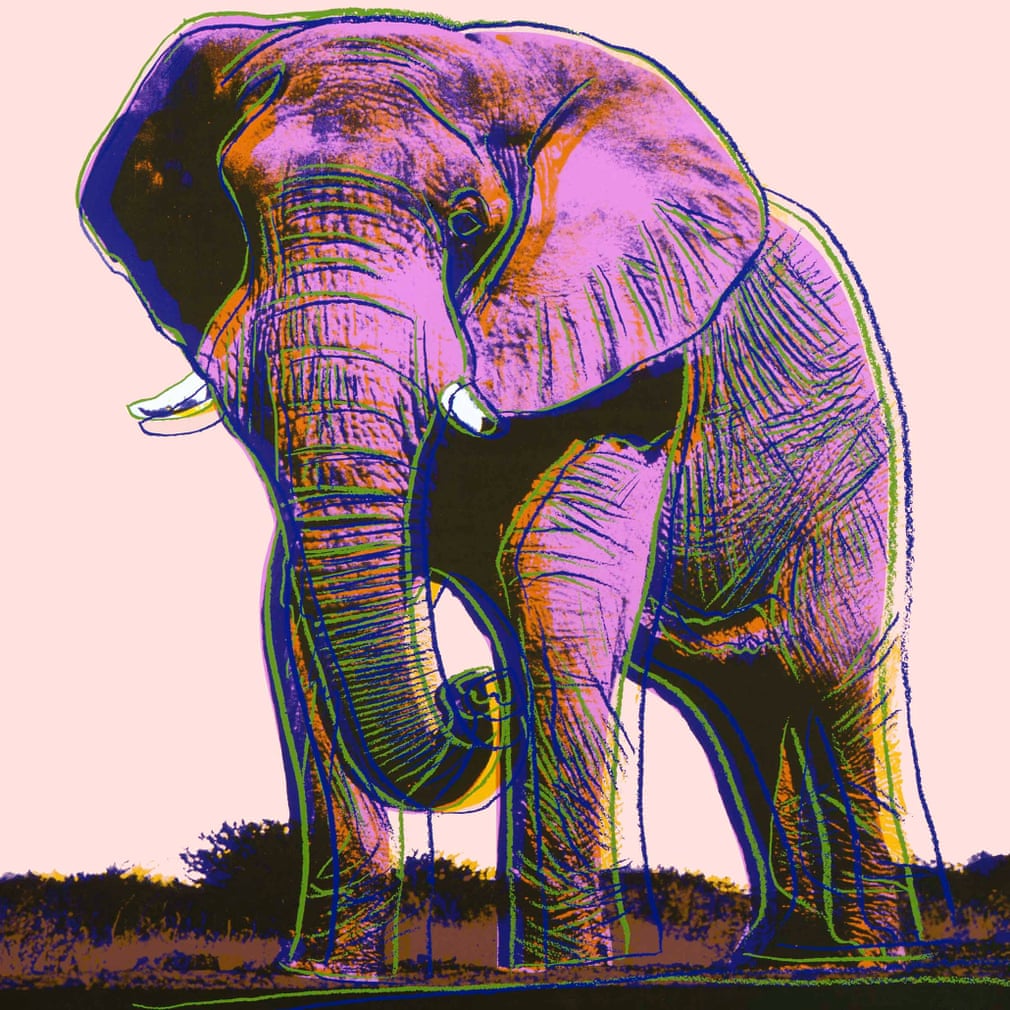
Andy Warhol’s 1983 Endangered Species series remain current in 2021. For more, visit The Guardian.

“The only true wisdom is in knowing you know nothing.”

—Socrates

Real knowledge is to know the extent of one’s ignorance.” (「知之為知之,不知為不知,是知也。」)

—Confucius (孔子)

If you’re in a writer’s group or if you’re an empathetic reader, you’ll probably ask or hear about the relationship between a writer and his writer’s block. I’m very fortunate. I seem to have more ideas than the cry of “Mamma Mia”—no offence to the Italians. The Italian interjection literally means “oh my mother.” I find no better emphatic phrase than “Mamma Mia” to express my surprise and frustration about unexpected occurrences and human errors. If you know one of the 250 hand gestures used by Italians on a daily basis, peppering up the cry of “Mamma Mia” with a hand gesture will certainly add a theatrical effect.

Mamma Mia (a hand gesture of surprise). I echo with the remarkable revelation of Socrates and Confucius. How did the two great philosophers come close to such a discovery of mankind’s ignorance without meeting on Zoom? Can I infer that the East and the West have more similarities in human nature than the ongoing bickering over development and democracy?

The more I learn, the more I’m aware of my knowledge gap. Writers like to say we write what we know. In fact, I ponder all the time when I write. Everything I write now will be a past tense of events and emotions by the time it is read by another reader. I dare not to misinform my reader even though you are the only one left. I also think we, the humans, are unique to project our feelings onto others, including humans, non-humans and even non-living things like machines and molecules. Recently, I watched a documentary film named “The Loneliest Whale: The Search for 52 (2021).” I find the framing of the word “the loneliest” on a whale quite successful. This is a perspective issue. The whale cannot tell you if he or she feels lonely. Humans can. Human beings can identify the feeling of loneliness and they are also relentlessly in search of the 52-hertz whale in the deep sea. Its call was first detected in 1989, then again in 1990 and 1991. 

Mamma Mia (a hand gesture of exasperation). 94% of Americans postponed their annual cancer screenings in the Pandemic’s second year. As a result, the diagnoses of some forms of cancer fell by more than 50% in 2020 when compared to 2019. Many cancer clinics suspended the collection of biopsies. I’m one of the 94% Americans who are losing sleep over which part of my body and mind will go wrong first. From a long-term perspective, an undiagnosed cancer crisis is unsustainable. Due to the increasing burden of cancer in China, the authorities have launched a series of projects on cancer screening and prevention. America has no reason to slow down its preventive healthcare services for more citizens. Like adopting climate mitigation and adaptation, preventive healthcare exemplifies what Benjamin Franklin said “an ounce of prevention is worth a pound of cure.”  

Mamma Mia (a hand gesture of joy). I can’t agree more with sociologist Eric Klinenberg. In his book titled “Going Solo (2013),” the author explains how technology has posed a big challenge to a society that favors individualism with a poor social welfare system. He wrote:      

“Today our species has about 200,000 years of experience with collective living, and only about fifty or sixty years with our experiment is going solo on a massive scale. In this brief time, we’ve yet to develop any serious public responses to the challenges related to living alone.”

If young generation is our future, how much have we invested and will invest in equal opportunities for young people? Our attention to the young generation under 30s really mirrors what sort of future lies ahead. In Greater China region, there is a popular term called “tangping (躺平),” literally meaning “lying flat,” to describe young people who are exhausted by a culture of hard work and working long shifts with seemingly little reward. Looking closely, I see many jobs in China today are algorithm-driven or telecommunication-related. The similar phenomenon occurs in Japan and South Korea. The more efficient our workflow is, the higher demand for the human capacity building both physically and intellectually. How can a human body compete against the fast data flow processed by AI?

If there’s a hot dog eating competition, I bet a robot that is trained to eat fast will win easily. In the Information Age, humans are under great pressure to absorb and consume food, goods and services in an environment that favors an insatiable, nonstopping, algorithm-driven feedback loop. The idea behind “tangping”—not overworking, being content with more attainable achievements and allowing time to unwind—perhaps is what humans should respond to this inhumane environment. Simply put, do not let digital devices take control of your life. Ever since AlphaGo won the first ever game against a Go professional with a score of 5-0 six year ago, I’ve been well aware of this subject that is beyond a writer’s block. It’s a mental block of mankind.

How can humans coexist and live together with animals, plants and now Smarter-Than-Us machines?

Solitary lifestyle is no longer a trend but inevitable. The digital devices seem to be integrated into our lives from cradle to grave. We rely on our devices more than we rely on our species. People often say they feel as if they have lost a part of their body if they go out without their smart phones. When I write here, I’m quite sad for the remote Pacific islanders whose right to a connected world is deprived by superpowers concerned with security of the sensitive undersea communications cables. This World Bank-led project was designed to improve communications in the island nations of Nauru, Kiribati and Federated States of Micronesia which are one of the world’s most vulnerable victims of rising sea levels. If there is one whale dubbed the world’s loneliest whale, why not also give attention to the world’s Loneliest Peoples who are soon losing their homeland because of climate crisis?

Globally, it’s common to see young people in their early 20s move back in with their families, to be labeled the “boomerang generation.” The Covid pandemic may have driven more jobless young people to live with their retired parents. Expensive urban living becomes more and more unaffordable for young people in both China and the U.S. Speaking of similarities, this is a common problem—housing affordability—for young people and young couples who want to start a family. They must become housing slaves, in particular in Chinese cities, Hong Kong, Vancouver, San Francisco, Manhattan and alike, for nearly their entire working life. Tangping, lying down, why not?   

According to the U.S. Centers for Disease Control and Prevention, U.S. life expectancy fell by a year and a half in 2020, the largest one-year decline since World War II. Despite couples that being on lockdown with their spouses or partners, the number of the U.S. births fell in 2020 to 3.6 million births, the 12th year of declining births in the last thirteen years. I see the pool of future tax payers in the U.S. getting smaller. What does it suggest to our future economy, social welfare and environmental protection?

The shrinking birth rate concerns Chinese policymakers, too. China’s latest crackdown on after-school tutoring is a gesture to create incentives for hard-working couples to make more babies. The authorities see the tutoring industry as a major impediment to raising the country’s birth rates as the exorbitant fees take up a big portion of the cost of raising a child. Under the new draft rules, the highly lucrative private education companies are to turn nonprofit. Interestingly, a national poll conducted by National Education Association last August shows that 40% of American teachers with 21-30 years of experience said they were considering early retirement or quitting the profession completely. Does that mean the great challenges of Zoom classroom and online teaching in the pandemic may have fundamentally changed our learning experience?              

(To be continued)

My Reflection on Independence Day 2021

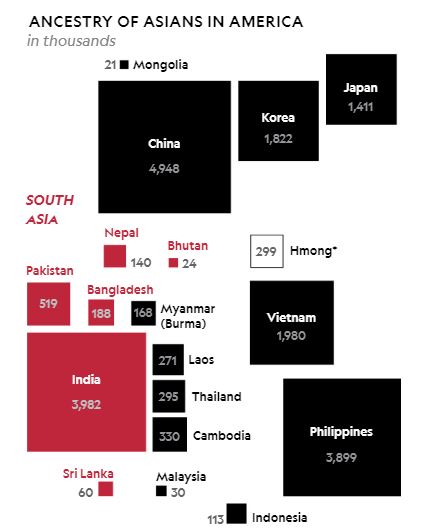
Asian-Americans make up most of the new U.S. immigrant population. Source: The National Geographic.

On this Fourth of July, I am sentimental as my mind is in the retrospective mode. Last year when I was in grad school learning how to become a sustainable development leader, I was introduced to a debriefing process called After Action Review (AAR). It was originally developed by the U.S. Army for analyzing what happened, why it happened, and how it can be done better. I found AAR very helpful in our teamwork last year. So almost every time after my cohort classmates and I completed a team project, we did AAR to review our learning progress and share lessons learned.  

This Independence Day also marks six months of my job search. I’m grateful that my resume has caught the attention to quite a few traditional institutions, ranging from government agencies, think tanks, NGOs and media outlets. Thank you for picking up some key messages in my resume and op-ed writings and for adding them to your latest job postings as well as strategic planning. This is a surprise to me because I told myself every time after I submitted my application that it would be like my submission to literary journals and agents. Don’t get high hopes because my application will be in the slush pile of others. It is true that what are the odds for a Chinese American—not to mention I’m not an ABC—to get accepted by a non-Asian employer or a publisher?

I remember fondly when I was studying creative writing in Pittsburgh, I frequented a Chinese restaurant ran by a Chinese American family. I saw European-looking servers in that restaurant and I was delighted. To a Chinese person, it was noticeable that a blondie was taking my order of Kung Pao Chicken and Chow Mein with beef; and my glass was often fully filled with ice water by an African American man in his early twenties. When I spoke Chinese to him, he was happy to practice speaking with me in my native language.

These days I feel nervous about speaking up on issues that matter to every American and even to every global citizen. That should not be the atmosphere in this country in which some controversial comments that one makes become a needle to others’ ears. We seem to yearn for compliments more than constructive second opinions. We seem to lose patience for others to finish a sentence. We seem to forget many historical events in different cultures share a similar outcome that human beings can be separated and even fight against one another as a result of miscommunication wrapped up in emotions.

I am still learning about my country. But in 2021 I am more confused than certain if my Chineseness can do me any good in this country. I am at the crossroad of my career in hope that the harmonic scene I saw in that Chinese restaurant in Pittsburgh a decade ago would happen to me in my career. I’ve learned a phrase from my American family these days. It’s okay that we agree to disagree. During my job search, I’ve learned to keep calm and be patient with my potential employers who may not agree with me. I told myself that I had done my best to introduce myself with sincerity and professionalism. The rest of decision making will be made by my destiny and the employer. As Aristotle said, “Patience is bitter, but its fruit is sweet.” A Chinese idiom shares a similar meaning. 苦盡甘來, pronounced “kǔ jìn gān lái” in Mandarin, literally meaning “bitterness finishes, sweetness begins.” I think this idiom is apt for anyone that is adjusting to change during the pandemic.    

If you cherish your ancestors who took a leap of faith to come to this country, you’d be easier to put into my shoes to understand that the first-generation immigrants are usually more passionate about the unity of our country, and are more vulnerable to discrimination. How can I be silent if I can speak English and write it like my mother tongue? I will keep on doing my AAR until I know how it can be done better in my sustainability advocacy and job search. I am grateful to celebrate this Fourth of July with my visiting family member under the same roof.     

 The Predicament of My Chineseness 
 By Karen Zhang | July 2021
  
 I came to this country alone
 With my high hopes for a place that 
 I can call home
 No one is curious about me until
 I recently spoke
 With indignation for the poor and the underdogs.
 Home, sweet home. Alas,
 My new home is wrecked by 
 The stereotype of a Chinese woman projected 
 By some non-Asian Americans.  
  
 I left a country that gave birth to me
 That I had no control of where my first home was.
 An outbreak of infectious disease has 
 Shaken me up like a slap on my face
 On one side of the Pacific, 
 I am labeled as the foreign influences
 On the other side of the Pacific,
 I am scrutinized by potential employers 
 because of my Chineseness.
  
 You are fortunate to read me on the page
 In your mother tongue English.
 Chinese people are not as fortunate as you
 That very few native English speakers write Chinese
 The way I do in English.
 I am eager to become your friend instead
 Of your foe
 I am passionate about building communication
 Bridges between the English world and China.
  
 Can you imagine how your non-English speaking 
 Ancestors making a living on this land that
 We all call motherland? 
 Can you distinguish the nuances between your English
 Pronunciation and your great great great 
 Grandparents’?  
 You are fortunate to read me on the page
 In your mother tongue English.
 I speak English before I set foot on this land
 My writing in English is good enough that
 You can follow me this far. 
  
 The pandemic has taught me to 
 Forgive but not to forget
 Forgive those who misunderstand me 
 That I am a Chink who spreads disease
 Forgive those who target me as a threat
 To their high positions of power and masculinity.
 Forgive those who suspect me 
 Out of my Chineseness. But 
 I will remember hard lessons from history
 That anger and fear are unique to mankind
 I will remember role models like 
 Nelson Mandela and Secretary Madeleine Albright
 Who taught me perseverance and peace
 I will remember what my late Chinese parents 
 Have bestowed on me to respect others 
 from the bottom of my heart. 
 You are fortunate to read me on the page
 In your mother tongue English.
  
 We need trust building as much as 
 Peacemaking now more than ever
 Forgive me if I tell the truth that hurts
 Forgive me if my words have discomforted you
 Real friends tell you the ugly truth not 
 Pretty lies. 
 I am eager to become your friend instead
 Of your foe
 Can you imagine how it would be felt to tell me the truth 
 in Chinese?
 Can you believe that we are Americans by nationality
 But we might look very differently?
  
 I am not a malicious "foreign influence" to either 
 Influential countries that embrace prosperity 
 for people and the planet.
 I am not an irresponsible global citizen 
 Of my only home called the Planet Earth. 
 I am not a member of the silent majority 
 In my literary world. 
 I am not a bystander to witness the severe loss
 Of biodiversity and linguistic diversity
 Who am I?  You might ask.
 I celebrate my Chineseness as proudly as
 Your ancestors whom I respect and 
 Whom observed their traditions before and after
 Their arrival to this land named
 The United States of America.  
  
 Do not tease me that your job advertisement says  
 To embrace diversity and inclusion 
 But I only see homogeneous culture in your
 Zoom meetings and recruitment process. 
 Do not change your job description to get my attention
 While you prefer free ideas from an anxious immigrant.
 Do not not to believe that you are part of 
 Our world of diversity and inclusion.
 Do not shut your door to the beautiful world
 Outside that is made up of 
 Various identities, languages, ideas and an
 Universal melody of unconditional love and compassion.
  
 We may have a generation gap about sustainability
 We can overcome it
 We may have a knowledge gap about sustainability
 We can talk over tea
 We may have a language barrier to fully
 Understand climate change
 I am here to learn from you if only 
 You show me the way to serve our 
 One and only home—
 The Planet Earth.
  
 I came to this country alone
 With my high hopes for a place that 
 I can call home
 I was born on this planet with diverse
 Flora and fauna predated my birth. 
 I left a country that may be stubborn now
 But dialogues will certainly help
 Humility is the true key to success.
 My Chineseness embraces humility and
 Humility is in my DNA.
 You are fortunate because if you will, 
 I can be your walking stick like that for the blind
 To show you a world that you feel strange
 But as friendly as you have never imagined.
 You are fortunate because you can read me 
 on the page in your mother tongue English.
  
 Don’t be afraid, my friend.
 Don’t be afraid, to myself.
 Honesty is the best policy.
 If I have offended you because of my Chineseness
 I just want to say—
 I am harmless.
 If I have provoked you because of my nationality
 I just want to say—
 Not every American is a bully.  

Living In The Karma of Indian Pharma

Image courtesy of Power of Positivity.

We must learn to live together as brothers or perish together as fools.

—Martin Luther King, Jr.

India is a big subject in global sustainability. This fact existed long before the COVID-19 pandemic. However, the dual crises—the pandemic and climate change—have put not only the Indian people but every global citizen together in the karma of health. This essay correlates with my previous two pieces titled “TITANIC Or CINATIT” and “The M-shaped Society.” What goes around comes around; this is a simple explanation of karma. The ship of covid TITANIC has reached its final destination, India.

India holds the key to determining the global success of the seventeen United Nations Sustainable Development Goals. Prior to the pandemic, India faced pressing problems such as environmental degradation, extensive poverty and gender inequality. In his book, Beyond Religion, the Dalai Lama cautioned:

As the glaciers recede, all the effects of deforestation, which is already taking its toll in greater levels of flooding. In the long run, deglaciation in Tibet could contribute to drastic climate change and severe water shortages and desertification in China, India, Pakistan, and Southeast Asia. This would be catastrophic for the whole world.

India is at the foot of the Himalayas. The country will be the first affected by the adverse effects of human-induced climate change. Early this February at least 31 people died and 165 people were missing following a Himalayan glacier disaster. Satellite images show a landslide and avalanche were the more likely causes of the disaster. India suffers water shortages but it is also the world’s biggest virtual exporter of water. These problems are worsening due to the pandemic. The discrepancy between the haves and have-nots in the country is widening in terms of accessing modern technology and vaccination. Tech-savvy Indians write code to secure vaccination whereas millions of others don’t even have access to smartphones or the internet, currently the only route to a jab.

The Reality of “Better to Give than to Receive”  

It is ironic that India boasts to be “the pharmacy of the world” but the people of India suffer from covid vaccine shortages. India halted vaccine exports due to domestic covid crisis. The ongoing restrictions on vaccine exports have already created supply problems for the WHO-backed COVAX program, a global initiative to ensure fair and equitable access to covid vaccines. Before India’s covid crisis became out of hand, Serum Institute of India (SII), which is the world’s largest vaccine manufacturer, supplied developing countries with COVID-19 vaccine doses via COVAX.

Indian drugs are indeed competitively cheaper than those in China. I remember a few years ago I watched a Chinese blockbuster called “Dying to Survive (我不是藥神)” in which a Chinese leukemia patient smuggled cheap and unproven cancer medicine from India for Chinese cancer survivors. Like the U.S., Chinese drugs see a hike in prices in recent years although they’re not as exorbitant as on the American pharmaceutical market. The karma of Indian pharma begins from unaffordable medical care for the most-needy people.    

One major reason that India is a strong competitor of China in pharmaceutical manufacturing is that Indian drug makers can produce essential medicines at cheaper prices. They pay lower wages. Preventing salary abuse is a human right. Salary abuse explains why most people in India were in the global low-income tier in 2020. According to Pew Research Center, in the last year prior to the pandemic, some 1.2 billion people in India account for 30% of the world’s low-income population. During the pandemic, the number of the Indian population that has fallen into poverty has increased.

Globally, in particular in the States, if C-suite professionals dislike seeing a zero or two missing in their total compensation, why should manual workers at the low rungs in the labor market accept gross wages that fail to honor their hard labor? Aristotle believed that no one in ancient Greece should have more than five times the wealth of the poorest person. His idea is 2,400 years old. But it might be today’s solution to narrow the income gap if we put up a wage ceiling to bookend the minimum wage laws. Narrowing the income gap will maintain a well-functioning democracy with a majority middle class, making a W-shaped society as I put it.

My theory is if the U.S. and India can narrow the income gap, a democratic and equitable international order will become the norm. The 21st century is the Asian Century. India’s success is humanity’s success to achieve sustainable development. Democracy is not to impose but to invite. Technology is to strengthen transparency but not to indulge greed. Socrates had famously said, “The unexamined life is not worth living.” Only when we do well can we influence others to do well. Narrowing the income gap is a good start to shape two basic principles of secular ethics—the recognition of our shared humanity and the understanding of interdependence. For further reading, Beyond Religion by the Dalai Lama is my inspiration.   

Herd immunity vs Herd mentality

If we could turn back time and if vaccine manufacturing countries could have replaced their habitual finger pointing and politicizing with information transparency and cooperation, the size and scale of covid infections could have been diminished around the world.

But there’s no ifs in reality. We only have lessons learned. China had a head start to develop a new vaccine last year when Hubei province became a coronavirus hotbed. But its draconian measures to control the spread of the virus led to a lack of infected people to complete late-stage trials for COVID-19 vaccines. In the meantime, the U.S. ranked at the top with the world’s most infections. This circumstance enabled American vaccine manufacturers to conduct the Phase 3 clinical trials directly at the source. According to the United Nations Children’s Fund (UNICEF), the U.S. tops the world as home to 110 COVID-19 vaccine developers, followed by 41 in China and 22 in Canada.         

Not every country has the manufacturing capacity for covid vaccines. And many developing countries don’t have the medical facilities or purchasing power for COVID-19 vaccines. But the best hope for the ship covid TITANIC not to sink is to achieve herd immunity among the global population of eight billion. Herd immunity is when a large part of the population—that is the herd—is immune to a virus. This can be achieved either because people got vaccinated or had already been infected. We definitely do not want a majority of passengers on the ship to get infected, so the majority of passengers getting vaccination is the way to achieve herd immunity.

Life does not make it easy for us, does it? A coalition of countries, led by India and South Africa, have petitioned the WHO to waive intellectual property rights so generic drug makers can begin producing the vaccines. But the drug makers from the U.S. and Europe oppose the idea, saying patents and the profits that flow from them are the lifeblood of innovation. I wonder if the incompetence of controlling covid infections in the U.S. last year was a well-thought-through strategic plan to ensure a large clinical trial population for the covid vaccines. If this is the unsaid and underreported intention of vaccine manufacturers, I’d strongly recommend they read Beyond Religion by the Dalai Lama to strengthen their professional ethics.

The Holiness wrote “The fundamental problem, I believe, is that at every level we are giving too much attention to the external, material aspects of life while neglecting moral ethics and inner value.

So the karma for Indian people, especially those underprivileged souls, is to get infected for herd immunity. The danger of this option to achieve herd immunity is allowing coronavirus strain to mutate. As one of the three subtypes of coronavirus B.1.617 variant, the Delta Variant is a fast-spreading coronavirus originating from India. According to the WHO, as of June 6, the Delta Variant has spread to 62 countries, becoming the dominant strain in the U.K, Guangzhou China, and Taiwan. The virus can often be asymptomatic and spread much faster than other “Variants of Concerned” under WHO’s naming system—Beta variant (South Africa) and Gamma variant (Brazil). According to a study in Britain, the Delta Variant cases have roughly doubled every seven days, although admittedly from a low base. However, covid jabs are most effective against the most severe outcome such as death, and less effective against less severe ones, such as asymptomatic infection.    

Image source: Public Health England

Last year we experienced panic buying ahead of covid lockdowns. This year when a U.S. pipeline was under cyberattack and suspended service, panic buying of gasoline was seen in some states in the east coast. Herd mentality is a key cause of panic buying. When we don’t see people wearing masks, we tend to follow suit and relax our own covid precautionary measures. This is herd mentality in which people tend to copy what other people are doing on a largely emotional, rather than rational, basis. Herd mentality is rampant especially when information is restricted and leadership is incompetent. On the leaky ship of covid TITANIC, I’ve seen passengers of different classes scuttling toward the direction they believe it’s safe but it’s not. The more people come together at one corner, the more likely the crowd will attract a bigger crowd. This is herd mentality. If you see someone get a jab and you follow suit, this is herd mentality. The more we are vaccinated, the sooner we will get herd immunity.

The nexus of Indian pharma and the environment

The negative impact of the production of pharmaceutical products on the natural environment is as dirty as e-waste recycling. I did an in-depth academic paper on e-waste recycling last year. Pharma pollution affects more directly and seriously those living near production plants. Their water and food sources are contaminated with waste pharma products. This is a global issue that the world must face. If big pharma doesn’t like to pay heavy fines to clean up contaminated rivers and soil, should it develop products with the theme “How not to take medicine to treat this problem?” Why not introduce paid health services such as online and in-person informational courses and activities about improving one’s attention and emotional support to reach the placebo sweet spot

According to Pharmaceutical Technology, the U.S. Food and Drug Administration and European Medicines Agency have not included environmental standards in their good manufacturing practices guidelines. The karma of Indian pharma sounds like a Superfund site, a polluted location in the U.S. that requires a long-term cleanup, except that it is located in India. This sounds like a lifelong case study of how pharma can get away with murder. If their living environment is as polluted as a sewer, where specimens collected from the sampling sites were contaminated with antimicrobials, how can Indian people improve their well-being?

Indian people have contributed too much to the world and yet they received very little from the world. So are the natural resources of the country being overly exploited.         

As the Delta Variant infectious cases rise exponentially in India, the country has been sluggish in distributing covid vaccines domestically. Covid-beleaguered India looks grim now and it needs lots of help from the international community. Since humanity is on the same boat, getting ourselves vaccinated is not enough. Why not save others’ lives to save ourselves too? The longer the first and second-class passengers are indifferent to the sufferings of the third-class passengers, the more likely new strains of coronavirus variants will be mutated and infect more people onboard, including some of the exclusive dignitaries in the first class.

We are living in the karma of Indian pharma. Drug pollution has polluted an increasing larger area that threatens human’s and non-human’s existence.

We don’t want to live in the covid karma 2.0, 3.0, 4.0 and so forth as a result of a more contagious virus.

Are you in this global fight to stop this covid nightmare that has haunted us for more than a year and half?

Shall we do what we can to save the ship by changing the course to a more sustainable future, that is the ship of CINATIT?  

The M-shaped Society

Welcome to stay onboard. Next stop for this ship of covid TITANIC is India, our final destination. Before we get there, we need a head count of the passengers aboard. There’s been a concern among political scientists and economists about the rising global population. Can the Earth handle a seeming uptrend of global population that is dependent on its limited natural resources? Does the ship of covid TITANIC have enough food and drink for her passengers?

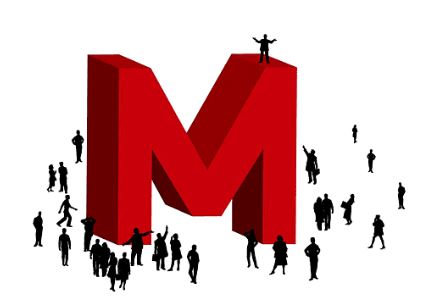
The letter M looks like a double-humped camel. Its shape describes vividly the polarized society with its extreme rich and the extreme poor. The middle class in a society gradually disappears. The concept came from William Ouchi, an American business educator. On the ship of covid TITANIC, the floors toward first class and third class are now packed with people. The individual distance for the first class is more spacious than that for the third class. The management will need to consider opening the second-class rooms for the third-class passengers to even out the weight of different part of the leaky ship.

The uneven distribution of passengers on the ship of covid TITANIC in reality is like the M-shaped society. To escape the pandemic, the extreme rich can fly on a private jet to a remote island instead of being housebound with social distancing. The extreme poor live in inner-city slums with children and elders so intimately that you’d wonder if they can be separated. You’d think 2020 is a terrible economic year for everyone. Urh-urh. As said in my previous op-ed piece, the large public companies in America are running a similar model synonymous to China’s central planning. CEO’s big pay packages are unscathed despite last year’s economic slowdown. An executive board of a company—like China’s Politburo of the ruling party—can make changes to the intricate formulas that determine their CEOs’ pay that can help make up for losses created by a crisis in general. Except that this is not a romantic relation between the poor and the rich, ABBA’s “The Winner Takes It All” speaks it all.    

China’s Politburo has given a green light to allowing up to three children per family to cope with the country’s aging population and shrinking labor force. Precisely, according to China’s 2020 Census data, the percentage of working-age people 15 to 59 in the population fell to 63.3% last year from 70.1% a decade earlier. The group aged 65 and older grew to 13.5% from 8.9%. The fertility rate in 2020 was 1.3 births per mother, well below the 2.1 that would maintain the size of the population.

It’s ironic that in my lifetime I’ve witnessed the rapid changes of China’s family planning policy from allowing only one child to two children per family in 2015, to today’s three children per family. In the U.S., a monumental policy change oftentimes takes decades or even two or three generations. No wonder legislation is always behind circumstances. If our founding fathers came back to life with artificial intelligence they would definitely point us to the ship of CINATIT, the reverse of TITANIC. All American passengers are protected by and benefit from—not only by words but by results—the true significance of the preamble of the U.S. Constitution. It reads:

We the People of the United States, in Order to form a more perfect Union, establish Justice, insure domestic Tranquility, provide for the common defense, promote the general Welfare, and secure the Blessings of Liberty to ourselves and our Posterity, do ordain and establish this Constitution for the United States of America.

The underlined words perfectly sum up the social pillar of sustainable development. This is a collective endeavor for generations. In fact, universally speaking, what makes the head of a state powerful is exactly because she represents the people. The people make up a society, establish a country and form a government. The people give meaning to the words “domestic,” “common” and “general” in the preamble. Nevertheless, the vision of our founding fathers is unfulfilled. What’s worse, it’s getting harder in the M-shaped society.

The M-shaped society in the U.S. is a warning that the leadership is steering away from the center. In the face of the pandemic and climate change, the common defense is more about building domestic infrastructure and a safety net for every citizen, leaving no one behind. History has told us that an iceberg caused the Titanic sink. The ship of covid TITANIC will encounter more than one iceberg.    

Time is ticking. The glacier is melting. And icebergs mushroom after breaking off the glacier .     

With respect to population growth, the U.S. doesn’t do well either. According to the U.S. 2020 Census data, the stagnation in national population growth persists. The current fertility rate in the U.S. is 1.73, better than China (1.3) but still below the 2.1  figure considered to be the replacement rate. Even before the pandemic, the U.S. population growth fell to its lowest levels in the past 100 years.

Why does the U.S. perform better than China in fertility rate even though China has the world’s largest population? Immigration. The U.S. legal immigration process allows global citizens to build a new life with their exceptional skills, to reunite with loved ones, and most importantly, contribute innovative ideas and expertise derived from diversity and inclusion to a new country that they call home. Some of the first class passengers on the ship of covid TITANIC are naturalized citizens of a few democratic countries that welcome immigrants. A number of the third class passengers are also seeking their way out with their talents to make a living in a democratic country that welcomes immigrants.   

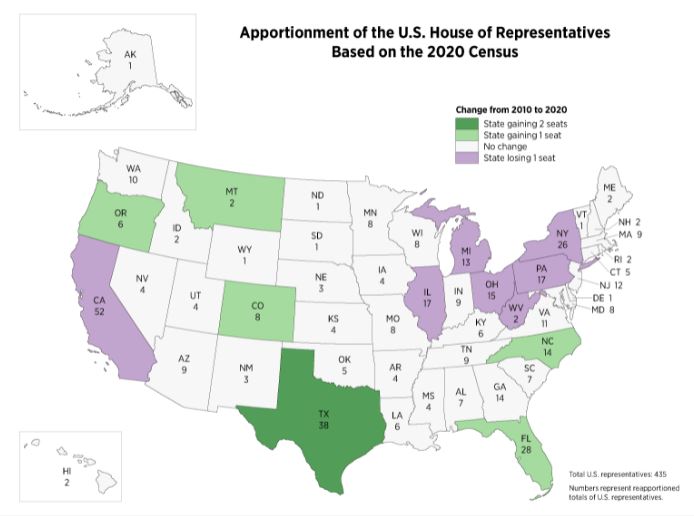
I didn’t know until I’ve researched for this piece of writing that the result of the U.S. Census has another meaning to lawmakers. It’s the barometer of political power of the party at the local level and federal level. I’ve learned a new word “apportionment.” This is an arcane term understood by few and confusing many education-deficient voters. The Cambridge dictionary explains it is “the act of sharing something between several people or organizations.” The American dictionary Merriam-Webster explains “the apportioning of representatives or taxes among the states according to U.S. law.” This is eye opening. It once again reaffirms my belief that big topics like COVID-19 and climate change require universal standardization and localized strategic plans. A word gives rise to different meanings resulting from its context. Not to mention that the user of the word has a different intention and represents different identity groups. Phew. Communication is a hard-earned degree.    

Source: The U.S. Census Bureau

Will the first class passengers on the ship of covid TITANIC be willing to contribute a bit more financially to repair the leakage of the ship?

Will the third class passengers on the ship of covid TITANIC be willing to stay calm and follow directions for safety?

Will the leadership of the ship of covid TITANIC be willing to put aside differences and simplify safety and rescue language and legislation?        

This is a universal basic public health code of conduct: mask adoption, contact tracing, quarantine and vaccination.

If it’s a bit difficult for some passengers on the ship of covid TITANIC to make the first step toward a shared goal: survive plus thrive, Dr. Helen Riess’s talk about the power of empathy will give you strength and hope in the Year of Healing of 2021.

In the information-overloaded Conceptual Age, technological development, if done right, can reduce extreme poverty. But if not done right will further accelerate wealth inequality. The M-shaped society is equivalent to greater inequality that fuels distrust and social unrest. A European study in 2018 shows that individuals whose income has grown less than others’ more often support radical right-wing parties. Not to mention those in extreme poverty are the first hard-hit victims of the dual crises—the COVID-19 pandemic and climate change. Those are the third class passengers on this ship.    

Back to my question in the beginning about if the rising global population will hinder economic growth and increase the rate of environmental degradation. I think Dr. Hans Rosling has the best yet explanation and projection of global population growth. We should not forget that the COVID-19 pandemic has already taken so many lives. A new study estimates more than 900,000 lives have died of covid in the U.S., a number 57% higher than official figures. So the pandemic may have slowed the estimated global population growth. Following Dr. Rosling’s no-one-left-behind projection of global population by 2050, we will transform the M-shaped society into the W-shape society in which middle-income families and individuals are a majority.

Embracing this feasible hope, may I propose that all passengers on the ship of covid TITANIC should comply with the simple code of conduct: mask adoption, contact tracing, quarantine and vaccination?

Don’t give up the ship.

—Commander James Lawrence, War of 1812

TITANIC Or CINATIT?

Which class of passenger are you? (Source: IB4UD)

For more than a year, I’ve been told by top-notch public health experts that every global citizen is required to normalize—but not minimize—mask adoption, contact tracing, quarantine and vaccination. Since I’m in my solitary confinement-like social distancing, I’ve stocked up plenty of food for thought. To make my cash-strapped life rich, I transport my rich mind to my birthplace Guangzhou, which is now battling the latest COVID-19 outbreak derived from the dangerous coronavirus B.1.617.2 (Delta) variant. As of June 1, this triple-mutant covid variant from India was reported to be detected in more than 60 territories, including the US. I wonder: Is humanity on the ship of covid TITANIC on which the poor and disadvantaged will die first? Or is humanity changing course on the ship of CINATIT, the reverse of TITANIC, with collective action to fight dual crises—the pandemic and climate change?       

It’s summertime. For such a weighty question, I’ll chew on it slowly this month while joining the global army of unemployment. Without any conflict of interest, I indulge my bold assumption that this phenomenon of unwanted job losses and willing workers without jobs will persist. It happens not only because human beings are unable yet to control the pandemic as a unified communal species but also because it is inevitable for all industries and governments of all sizes as well as every global citizen to make timely decisions and action with sustainable development in mind. 

When I threw my caveat this early February in my previous op-ed piece, I had questioned whether humanity was racing against time with coronavirus variants, the vaccine distribution and administration. I didn’t expect my caveat to become a reality. China and the U.S. have presented two drastically different approaches to handling the local outbreaks. But this is a pandemic that requires global alignment and commitment. We’re on the same boat. What’s the point to argue about which captain should steer the wheel when the boat is leaking?

Whether it’s COVID-19 pandemic or climate change, the people who suffer the most, and sadly even die without being known, are those in the third and second class of passengers on the ship of covid TITANIC. The wealthy and powerful have their means to hang on a bit longer. Fly to another island maybe or deploy troops for unnecessary fatal killings.

Don’t forget we are living on the same planet. For those innocent people who will die for history that is written by the victors, they will rest in peace. However, the last surviving first class passengers are most likely to live in painful memories and loneliness. As long as we live, we remember things. The power of memory makes us human. Loneliness comes from the lack of competition that brings progress and prosperity. So, do you really think a solo captain will be happy ever after?

I have this May dataset from the U.S. Department of Labor that stuns me. There are 9.8 million out-of-work Americans today. Remarkably, there are 8.1 million job openings today. If the former group would simply get in touch with the latter group, would that not solve our nation’s 6.1% jobless rate? The problem is that the 8.1 million job openings—the highest number recorded in U.S. history—has increased by 1.2 million in just the last two months. Employers nationwide have been underwhelmed with the quality of job applicants submitting resumes, resulting in millions of jobs gone wanting.

The word “underwhelm” has caught my eye. Does the employer have a high expectation for the candidates? Or have the worn-out applicants learned to stand up for themselves for a secure and respectful workplace? As an ordinary job seeker who understands crisis management, I can’t help thinking the current dual crises are more of an opportunity for the human race. Crisis (危机) in Chinese is composed of two characters, wēi means danger, and means opportunity.

The commonality of the pandemic and climate change first and foremost is boundary spanning. This is a term in social science and yet I’ve generalized it to apply to the context of my subject matter. Simply put, if every capable worker is human capital for an employer, the human capital like myself that can play the role of linking the organization’s internal networks with external sources of information is considered boundary spanner. To seize the opportunity of sustainable development, lifelong career training becomes crucial from C-suite to assembly line technicians because the SMART machines that we rely on bring us information and problems quicker than ever before. Specialists are important but generalists who know boundary spanning well are equally invaluable. The pandemic and climate change are both global challenges without borders. So we need a mindset and workforce that can embrace diversity and inclusion. Will this logic explain some of the underwhelmed condition in the job market between employers’ advanced fuels-model expectation and applicants’ fossil fuel model-status quo? Or vice versa.    

Let us read a 400-year-old poem by John Donne before you join me onboard to the ship of covid TITANIC that is heading to Guangzhou for a field study. According to China’s 2020 census, Guangzhou has an urban area population more than 18 million inhabitants.

 No Man Is An Island 
 By John Donne
  
 No man is an island 
 Entire of itself, 
 Every man is a piece of the continent,
 A part of the main.
  
 If a clod be washed away by the sea,
 Europe is the less, 
 As well as if a promontory were,
 As well as if a manor of thy friend’s 
 Or of thine own were.
  
 Any man’s death diminishes me,
 Because I am involved in mankind. 
 And therefore never send to know for whom 
 the bell tolls; 
 It tolls for thee. 

Coronavirus is like any given hurricane or earthquake. They both share the same trait of boundary spanning as I put it. Coronavirus has no eyes. It hits the ground running wherever the environment is suitable and whenever the timing is ripe. Similarly, a cyclone hard-hit region will see more intense and frequent natural disasters as a result of adverse effects of climate change. On the same day of May 22, just hours apart, China was hit by two massive earthquakes, killing at least three people. The U.S. Geological Survey measured the Qinghai earthquake at a magnitude of 7.3 and the one in Yunnan at 6.1. No official update of the death toll since. But if I refer to old stories, I may dot my i’s and cross my t’s. In 2010, a 6.9-magnitude quake in Qinghai left 3,000 people dead or missing.

As for COVID-19 prevention and control, China leads the world with respect to early contact tracing and mask adoption. However, when people relax their mind of wearing masks and return to business-as-usual crowd gathering, they also provide an ideal environment and condition for coronavirus variants to mutate and spread. That’s exactly what happened. During the May 1 Labor Day holiday week, Chinese people relaxed mask adoption and traveled about across the country. Two weeks later a positive covid case in Guangzhou was confirmed, and then all hell broke loose. As of June 3, half of the city was in lockdown and a citywide massive contact tracing was performed within three days. That’s 18 million people strong.

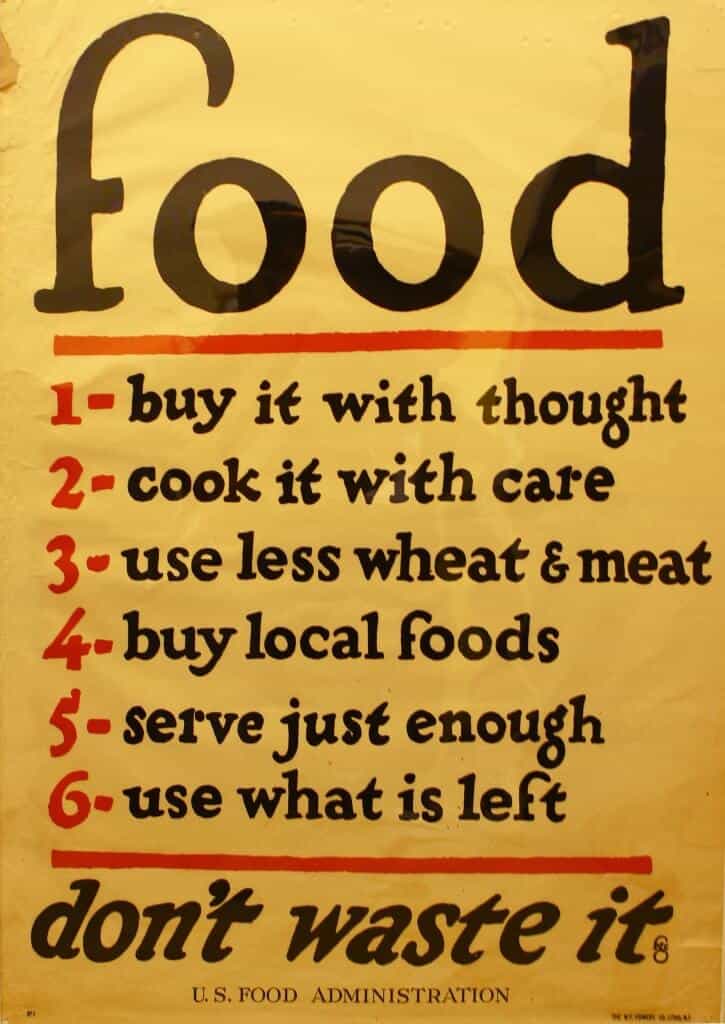
As of this writing to my knowledge, no American municipality has a sophisticated and thorough contact tracing system. Plus, from mask adoption to testing and tracing, Americans had never been in unison at the outset of the pandemic. Globally, rich countries are hoarding more covid vaccines than their nationals, among whom reject vaccination resulting from misinformation. Like food waste, vaccines have their expiry dates. On the one end, vaccine manufacturers say they cannot produce large quantities of vaccines within a short period; on the other end, many vials are unused and on their course toward expiration. On the one end, vaccinated people minimize covid precautions; on the other end, medically disadvantaged people are dying from covid in the meantime engendering seemingly unstoppable covid mutation.

We must respect Darwin’s law of natural selection.

Whether you’re pro-life or pro-choice, the ship of covid TITANIC has something for you to respond to. Do not let more innocent lives die. Get off this ship as soon as possible.

Whether you’re hawkish lobbyists or dovish strategists, the ship of covid TITANIC will make your career shine only if you don’t let it sink. Learn to smile to your opponent, or better, a handshake, will make your survival rate high in the lonely world of yours.    

Whether you’re a stable breadwinner or an anxious soul like me in the job market, the ship of covid TITANIC gives us nothing but a key to the future. Think and learn on your job and out of your job. Ask how to enrich myself with unlimited growth with limited resources. 

The recent COVID-19 outbreak in Guangzhou China [map] has raised an alarm to the world. The authorities confirmed that recent surge of new infections are contracted with a fast-spreading virus strain detected in India. At about the same time, Vietnam has detected hybrid of Indian and UK Covid-19 variants. How much do we know about the B.1.617 variants which could expedite the leakage of the ship of covid TITANIC?

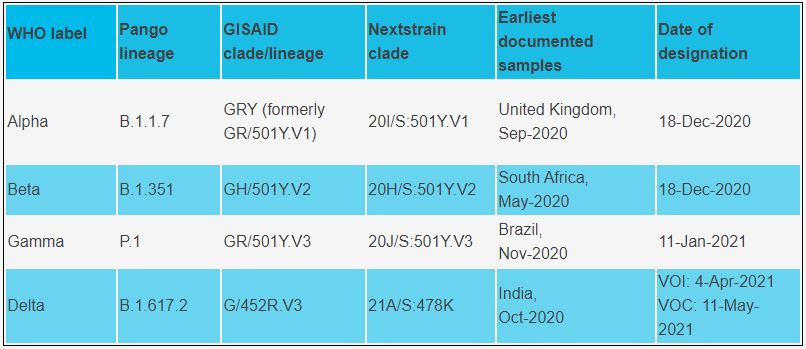
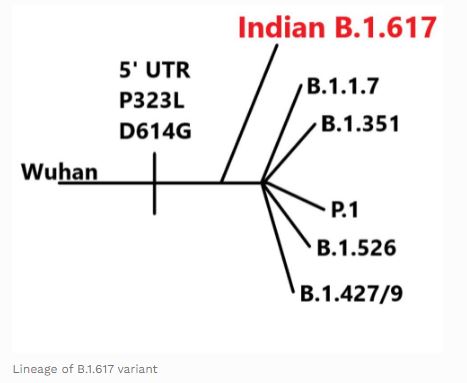
Since coronavirus B.1.617 variant was first reported in India late last year, researchers have since identified three subtypes, known as B.1.617.1 (the “original” B.1.617), B.1.617.2 and B.1.617.3, each with a slightly different genetic make-up. To avoid stigmatization related to COVID-strain names, the WHO has adopted a global naming system by using Greek letters to name SARS-CoV-2 variants. The emergence of variants is characterized into Variants of Interest (VOIs) and Variants of Concern (VOCs) based on risk levels to global public health. For example, the B.1.617.2 coronavirus variant originally discovered in India is now named “Delta Variant.” Corona beer took a hit because of its name similarity to the deadly virus. I wonder how the “Delta Variant” will impact the Delta Airlines or perhaps a boost for marketing.        

Four COVID-19 Variants of Concern (VOCs). Source: WHO.

Public health experts learned that the genome and proteins of B.1.617 differ substantially from the multiple variants found in California and in New York that are currently circulating in the U.S. As said, we must respect Darwin’s law of natural selection. The Delta Variant may be heat-tolerant that allows it to spread fast and wide. If this hypothesis is proven, global warming cannot be more inductive to viral mutation. And the summer won’t offer a reprieve but allow the new variants become far more contagious than previous strains. Nevertheless, the U.S. has hailed relaxed CDC guidance for fully vaccinated Americans and Americans have celebrated with Memorial Day travel frenzy. Will a new wave of covid infections be far behind?

Source: Forbes.com

As said, even in a covid tightly control country like China, Guangzhou’s latest outbreak has raised an alarm to the world. I cannot imagine what devastation the covid TITANIC with the Delta Variant will cause in South Asia, Africa and South America where vaccination distribution and administration have fallen far behind. Poor second and third class of passengers are on my mind all the time.

Every global citizen has the right to inform oneself about what is the next iceberg to watch the covid TITANIC is heading. The WHO issues weekly situation reports (detail). As of May 30, India and the United States, one developing country and one developed country, remain on the top the chart of death tolls respectively. 

Global COVID-19 cases as of May 30, 2021. (Source: WHO)

Johns Hopkins University Coronavirus Resource Center also provides credible information about each state and country (detail). Stay alert and safe is all you need to do. The ten lessons in crisis management from COVID-19 to climate change by the Aspen Institute is a good self-taught boundary spanning reference to many prosperity-yearning-and-socially-conscious Americans.    

Absolute freedom does not exist unless you’re not a social animal called human. When one’s freedom becomes harmful to others, that is not freedom but selfishness. Only when humans are doing things right with their own ability and for a broader sense of global community can we jump ship to CINATIT in a timely fashion for a sustainable future for all.  

A Hard-Earned Degree

Suez Canal reopened after stuck cargo ship was freed. Image courtesy of the Associated Press.

This is a true event that has put me into deep thinking for several weeks. I earned a second master’s degree and a certificate in global sustainability last December. I was informed by my alma mater that I would receive these two documents by postal mail this March. Due to COVID-19 restrictions, mailing delivery by USPS and online communication between people who telework may be slower than under normal circumstances. But never should COVID-19 become an excuse for scatterbrains to dodge duties that require full attention and execution.

Everyone is her own boss. I didn’t receive the two academic documents as scheduled, and I had to be my own advocate to follow through about the unfinished business. In my message to my alma mater I’d stated clearly and precisely—unless the recipient didn’t understand English—that the two documents had not been received. I enclosed my message with my detailed personal information. My email didn’t get a response. I wrote a second email to my department’s program coordinator and finally through her I had my answer. The school agreed to resend the academic documents to me. To my delight, on April 17 I received my diploma. But my certificate was not in the same mail. My admin professionalism got called out. Again, I wrote a follow-up email; again, no response from the administrator; and again, through the helpful coordinator, I had my answer. The school agreed to place a new order for the certificate. It would arrive in a month. A domestic postal service takes a month? I wonder where the certificate is manufactured and shipped from.   

My misfortune in communication hasn’t ended. This is a second case study based on my real life experience. I was able to receive my first jab of Pfizer vaccine in early March. I was told on site that the system in which I registered would notify me in the following three weeks for a second shot. That was a human-to-human conversation. So no way did I not believe what I heard. After three weeks had passed and I was still naively waiting for the notification that I was promised, I realized that my hope was false. So in the fourth week after my first jab, I dialed the hotline of the vaccination provider. Before I could finally speak to a human, I had to go through a host of unintelligent questions asked by a supposedly intelligent robotic voice. In the end, I was scheduled to have my second shot of vaccination in early May because the April calendar was already full.

If time is money, I really wasted a substantial amount of money on a daily basis to conduct business with human-to-machine dialogue. Oftentimes I have no choice. It’s not that I don’t want to communicate with a human but the customer service end is more likely equipped with some sort of computerized technology. Where do the humans go?

Moreover, in my first case study, I know the administrator wasn’t deliberately overlooking my early email request for two academic documents. But why would he send only one document to me? My analysis is when machines have won the trust of humans, humans are prone to nonperform and ignore basic skills. If we continue to perform due diligence with or without the assistance of an electronic device, our vigilance will remain as sharp as a pin. This is one of the reasons why I do not take digital convenience for granted. Multiple studies show the more we chew our food, the more nutrients and energy our body can absorb. The less we use our brain, the dumber we become. Can I infer that if we rely on robots to finish our sentences, we will lose the ability—let alone the pleasure—of carrying out an in-depth conversation with our human species?           

Since social distancing kicked off in 2020, the impact of artificial intelligence in medicine has been the swiftest ever. If the pandemic enables healthcare providers to replace their human employees in customer service with humanlike robotic voices and mobile applications, I’m afraid that we will be living in an ever-more stressful society. Technostress is not something we can sweep under the rug. Technostress gives rise to anxiety, depression and loneliness. When we feel lonely, especially when we are practicing social distancing, we tend to seek pleasure, for example, from an online shopping spree. The more we buy, the happier we believe we are. The sellers are definitely the happiest. Every consumer is contributing to the piggy bank of Amazon or China’s Taobao with their hard-earned money and unique personal data. This is how overconsumption, overproduction and overpollution form a reinforcing vicious cycle.

Speaking of personal data, I have the third case study. I received a brochure by mail from my bank, in which it read:

Privacy notice—your right to opt-out, providing us with access to your information permits us to offer you distinct advantages and better service. Blah, blah, blah, blah, blah, blah, blah, blah, blah, blah, blah, blah, blah, blah, blah, blah, blah, blah, blah, blah, blah, blah, blah, blah, blah, blah, blah, blah, blah, blah, blah, blah, blah, blah, blah, blah, blah. . . Unless you tell us otherwise and opt-out, (i) the XYZ Company (ies) with which you have a business relationship may share information about your creditworthiness with other XYZ Companies or (ii) other XYZ Companies may use your personal information for marketing purposes.”  

If businesses are really serious about protecting consumer’s personal data, shouldn’t the literature be rewritten as “Your right to opt-in”? It’s my data, I have the right to release it the way I want. On what grounds is my data already sold to my bank without my knowledge so that I have to take initiative to getting it back? How many users will read through the customized Cookie Law from the website they’re about to surf? I bet many users just select “Accept” without a second thought. The update of a browser and mobile applications is an upgrade for the service providers to perfect the technology of gathering customer’s data to their advantage. As said, we are our own boss but we are not our own lawyer. Not to mention those who are illiterate, disabled, and mentally challenged and unable to protect their data. If the purpose of collecting data is merely for profit with little regulation, it will make the disadvantaged more vulnerable to cybercrime and other adverse consequences.

On March 28 this year, a cargo ship was stuck in the Suez Canal near Suez, Egypt. It took nearly a week before salvage teams freed the colossal container ship. However, over 420 vessels that awaited to use the busy canal were victims as well. Billions of dollars a day in maritime commerce was lost like vapor. I had thought this story could have appeared in the newspaper in the 1960s, not today. In the digital era, shouldn’t problem-solving communication resolve such a shipping crisis faster and more effectively? What held up the communication in this case study? We might blame technical problem for communication. Poor human-to-human communication is a pre-pandemic problem. It will get worse if we cannot strike a balance between in-person communication and algorithm-driven communication.

Technology is a double-edged sword. While we’re acknowledging its advantage to humanity especially in science research, supply chain management and addressing socio-economic inequalities, we must also acknowledge that technology can increase societal insecurity and psychological imbalance. Inviting technology to this complicated and complex communication interface, we are merely adding or replacing the old problem with a new challenge. We, as humans, have never stopped learning since birth how to communicate well. The art of communication is a lifelong science in and of itself. This is a hard-earned degree.    

A Forward-Thinking Foodie

This is a proposal for my fellow human species who are willing to take action to build a circular economy. That is, we don’t need to give up economic development for the wellbeing of humanity, but we need to transition to a circular economy to replace the current “take-make-waste” linear model. A circular economy aims to gradually decouple growth from the consumption of finite resources.

You may ask, which are the finite resources? Water, land, minerals, fossil fuels, metal ores, nuclear energy and more. If we rely on technological advances to guide us to a sustainable future, we need to worry about the depletion of critical minerals which are the bones and blood of new technologies. If we need an undisrupted food supply to survive, it’s paramount to rethink how to protect our food sources, including their supply chains that are vulnerable to any pandemic-like crisis caused by climate change. I’m a foodie. So I have to think ahead to better prepare myself for rising food prices due to shortage of supply for certain food items.

Aside from water resources, food sources are the most vulnerable area of concern for human existence. Does it ring a bell to you when your local supermarket ran out of milk and meat at the outset of COVID-19 in 2020? It wasn’t because we ran out of the particular food item from the farm but it was the sudden halt of the supply chain due to the pandemic that delayed the schedule of transportation. In fact, many dairy farms suffered great losses because their dairy products went bad before they could be transported to local markets. This was food waste of the pandemic. Food waste is not limited to any food discarded in the supplier end. It also applies to the consumer end.

Indeed, when you learn about the data, you might be as astonished as I am. In the U.S., food waste is estimated at between 30-40% of the food supply. This estimates 31% food loss at the retail and consumer levels, corresponding to approximately 133 billion pounds and US$161 billion worth of food in 2010. On the other side of the world, wiping out hunger in Africa could cost US$5billion. Domestically, the healthcare costs of hunger and food insecurity for the year of 2014 in the U.S. are estimated at $160.7 billion. Simply put, your tax dollars haven’t been put into the most effective federal program to achieve zero hunger, which is the United Nations Sustainable Development Goal 2.  

Globally, you might think political will is our enemy to fight climate change. No, it’s time. We are heading for an irreversible future in which extinct species are forgotten quickly and global warming is unstoppable. We don’t know when the next natural disaster will hit us or when the latest hottest day will overwrite the previous record in a shorter period of time.

When we are questioning what the country can do for us in response to climate change, let us ask what we can do for the country to protect the shared homeland for humans and non-humans in the face of climate crisis.

Scientists have shown us that a third of food is lost or wasted. Eight million people, equivalent to the population of New York City, don’t have enough to eat. And it is estimated that 8-10% of global greenhouse gas emissions are associated with food that is not consumed. These numbers may not matter to you immediately but like any relationship, it takes time to feel the domino effect from one end to the other. Few global citizens knew a Chinese city called Wuhan in November 2019. But the city has earned its unfortunate global fame whenever we mention COVID-19. The world is interconnected. A change in one part of the world results in a change in different parts of the world. A region suffers from war, plague and natural disaster, Wall Street futures fluctuate. What if we are investing in a circular economy?   

A circular economy enables us to imagine and implement a zero waste food system. As the Earth’s temperature is rising, more extreme heat throughout the year and irregular seasonal changes will impact farming activities. New pests, pathogens and weed problems also raise fear for crops and food security. A mechnism of reward and punishment needs to be in place to monitor food waste from farm to fork and motivate consumer behavioral change toward food management in each household.

China has passed an anti-food waste law to intervene consumer food waste. Serious restaurant violators that are found guilty of inducing behaviors that lead to diners wasting food will be fined up to ten thousand yuan (approx. US$1,546). The U.S. Environmental Protection Agency has released a food recovery hierarchy in four different languages (English, Chinese, Korean and Spanish) to encourage citizens to prevent food waste. Speaking of behavioral changes, shifting diets away from so much beef and toward more plants is a win for the climate. Producing beef requires 20 times more land and emits 20 more times more greenhouse gas emissions than producing common plant-based proteins.

We need to consume nutrient-dense food including vegetables and fruits. The U.S. federal government spends more on diabetes treatment each year—$160 billion—than the U.S. Department of Agriculture’s annual budget. Poor diet is a major driver of chronic disease. In a circular economy, organic resources such as those from food by-products can safely be returned to the soil in the form of organic fertilizer. We can turn food waste into compost, a soil-like product consisting of organic materials such as leaves, grass clippings and certain kitchen scraps. We can apply compost to our vegetable gardens and farms. This is a natural way of returning needed nutrients to the soil. If you have a farm or a vegetable garden, regenerative farming practices are effective to protect our food sources with nutrients.

There is no better time than now for global citizen of all ages to educate and re-educate ourselves in climate solutions. When we say that all climate solutions are needed to draw down greenhouse gases, we must also mean education solutions. The more we know from credible sources and ruminate on the nexus of food and our existence, the more we will appreciate the beauty of our planet and change our consumer behaviors for a sustainable future.

If you’re a forward-thinking foodie like me, I invite you to ask yourselves more questions before you buy, eat, and throw away food. We’re familiar with these very questions of existence:

Who am I? Why am I here? Where did I come from? Where will I go to?

What if we raise the same questions for the food that we cannot live without?

Ask, where does the corn come from? Why do I need to eat it? Where will the corn go to if I dump it in the same trash can that contains non-biodegradable waste?

Check out below video of the third grade science that adults need to relearn.

If a circular economy inspires you as much as it does me, I have two success stories to share with you. The African country of Uganda is one of the world’s largest consumers of bananas. A local startup transforms banana stems into rugs, fabrics and hair extensions.

During the pandemic, we’ve produced a large amount of used disposable masks which contain plastics. The accumulation of plastic waste has suffocated sea life and polluted the marine environment. Before becoming a delicacy on our plate, our fishery and seafood products are likely to eat plastics, too. Do we need to adapt to a plastic diet, too? A South Korean furniture design student melted the face masks to make stools that he called “Stack and Stack.”

The effects of global warming and human population growth have revealed the profound insecurity and inequalities in our global ag-food system. This linear ag-food lifecycle must be shifted into a diverse and sustainable farming system in order to increase its resilience to the adverse effects of climate change. If businesses are seeking long-term profit, they should lead consumers to their eco-friendly products and recycling and education programs. To save money and eat healthy is how I shop for food and eat with mindfulness. Don’t waste food is step one and also a feasible step for everyone to transitioning to a circular economy.

“A sustainable agriculture is one which depletes neither the people nor the land.”

— Wendell Berry

From Technostress to Tree Therapy

Are you working from home? Do you have a window in your home office? Can you view nature from your window while working? Do you have the luxury of taking a five-minute break from work to be near a houseplant? Or better, do you have a lunch break to stand or sit or lie down under a tree? In the world of Zoomtopia, we may need to spend more quality time with trees to reduce our technostress.

Last December, I wrote an essay titled “Biophilic Rhapsody.” Since then I’ve enjoyed shinrin-yoku (森林浴), forest bathing, whenever I can despite the COVID-19 restrictions. I’m blessed that I have a view of a big tree, which I once considered an eyesore, from the only window in my space of solitary confinement. A number of researches that are illustrated in Dr. Qing Li’s book titled Forest Bathing show a “green micro-break” can restore us when we are mentally fatigued; a brief glimpse of the color green before doing a creative task is enough to “enhance creative performance”; and a look at a picture of nature is enough to “improve cognitive performance.” 

According to the World Health Organization, stress is the health epidemic of the 21st century. While high-paid professionals can receive stress-related counseling and therapy from their employer-sponsored health insurance, low-paid workers, many of whom are part-time contractors, are not that fortunate in coping with their job-related depression.

The right to health is central to the United Nations Sustainable Development Goals (SDGs), precisely SDG 3. And yet this human right is not widely achieved, not even in rich countries like the United States. Some say that the taxpayers will be burdened by those who cannot pay for their medical bills. If a society is composed of a large number of consumers who are either medically uninsured or are unable to access health care services, do you think the consumer market will be healthy, too? Working professionals become too sick to work, reducing productivity; lower income ensues. Low income slows the market. The pandemic year of 2020 was a testament to this phenomenon. Do you think the well-paid middle class can live safely alone when depressed fellow citizens turn grievances to violence? For the high-earning taxpayers, the price you need to pay is either to contribute more financially to a healthy medical care system for all or to suffer more unexpected societal insecurity and life-threatening risks. After all, when the poor make progress to enter a higher social class, they also need to pay their fair share to a healthy medical care system. Stress prevention relieves money stress and societal stress.   

Technostress is part of the big family of stress. The word “technostress” was coined in 1984 to describe unhealthy behavior around new technology. The symptoms include checking your phone constantly, compulsively sharing updates and feeling that you need to be continually connected. Scientists warn that digital addiction increases loneliness, anxiety and depression. What’s worse, a growing number of scientific researches report that rising temperatures give rise to negative effects on mental health, including a potential higher rate of suicide. Have you been to the markets in a tropical country? If you have, you’d notice local vendors speak louder than their counterparts in colder countries. I’m not surprised to hear more people shouting at one another around the world as atmospheric temperature goes up and summer becomes longer. Global warming and forest loss conspire to create warmer, drier conditions, which in return render forests loss more vulnerable to fire and pest infestation. Subsequent burning and decay release more carbon emissions, feeding a vicious cycle.

Source: Global Forest Watch

Our health and the health of the forest go hand in hand. We can’t have a healthy population without healthy forests. Forests absorb twice as much carbon as they emit each year, providing a “carbon sink” that is 1.5 times more carbon than the U.S. emits annually. However, from the Amazon rainforest to the Congo rainforest, we’re losing forest at a rapid speed. Each year, more than 32 million acres of forest are lost across the world. That is an area around the size of England. Among the ten golden rules for restoring forests published by the UK’s Royal Botanic Gardens, Kew, this January, working with local people is Rule number two. This is a win-win solution for the underserved communities and the indigenous peoples around the world.

When indigenous peoples are present in forests and their rights are strengthened, forest cover is maintained. I remember the well-told story about the Lewis and Clark Expedition in which indigenous knowledge, accumulated over generations through direct contact with the environment, had provided invaluable guidance to Lewis and Clark. I’m also in awe and wonder about the powerful efficacy of traditional Chinese medicine (TCM). TCM is strictly based on the practicing experience of medical professionals dated back at least 2,200 years and does not depend on scientific evidence developed in Western medical labs. The ancient human knowledge dates back long before the first, second and third Industrial Revolution and the big data era with Amazon and Google.  

The depth of shamans’ knowledge on preventive medicine and diagnostics is as fascinating as the social adaptive capacity of the indigenous peoples to adjust to or prepare for changes. If the year of 2021 is the Year of Healing, perhaps we should listen more to these native healers whose livelihoods are threatened as a result of their loss of habitat (Learn more click source 1 and source 2). During the Edo period in Japan, the ruling samurai class protected the trees that grew in the Kiso Valley (木曽路). They were only to be cut for the houses and temples of the powerful families. The violators would be punished—if you cut down a tree, your head would be cut off. In the Indian mangrove forest called the Sundarbans, locals worship Bonbibi, a forest goddess. They make vow to the goddess to take no more than they need from the jungle. If humans don’t respect and protect forests, who will?

If human activities have crossed the boundaries into the environment and virtual space, shouldn’t laws, regulations and standardization be expanded to these domains where human activities set foot?

In children’s books we often see trees, plants and animals talk to humans. If they can talk to humans, we’re suppose to protect them and value them as members of the planet. Perhaps in my own fantasy, children can be better leaders and be more accountable than adults to protect the existential relationships between humans and non-humans. Mother Nature has many sounds. If you want to feel the healing power of trees, disconnect yourself with your electronic devices and connect with a tree. Give yourself a treat to listen to the 100 soundscapes of Japan, for example. Or read more about how to live more respectfully with plants. Natural silence has been called one of the most endangered resources on the planet. Trees and shrubs are a cost-effective noise barrier. Why not become a tree hugger to let the music of nature rescue and restore our humanity?